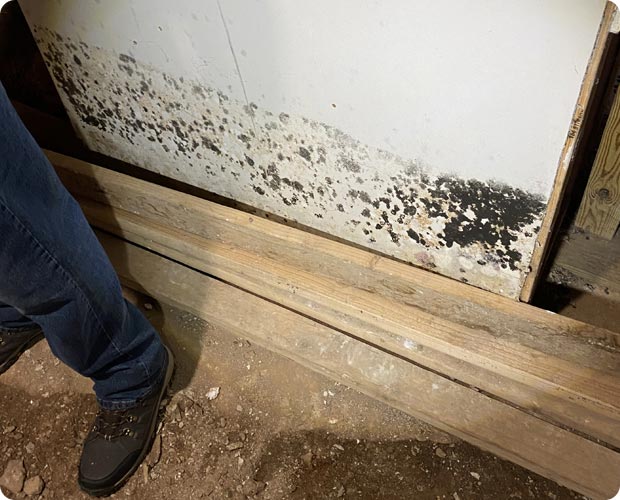
'Black mold' is a term used loosely for anything dark and alarming, but in remediation it specifically means Stachybotrys chartarum — slimy, black to dark greenish-black, and slow to establish: it typically takes 8-12 days of sustained wet conditions on cellulose material (drywall paper is ideal) to take hold. That slow timeline is actually useful context: Stachybotrys usually signals a chronic, undetected leak or a flood that wasn't dried out fast enough, not a one-day event.
The 'toxic mold' framing overstates some things and understates others. Stachybotrys does produce trichothecene mycotoxins, and it does warrant professional remediation — that concern is legitimate. But whether it causes illness in a given household depends on mycotoxin concentration, exposure duration, and individual sensitivity, which are questions for a physician or certified industrial hygienist, not a remediation contractor.
A quirk that matters for testing: Stachybotrys spores are heavy and sticky, so they often don't aerosolise readily and can be absent from air sampling even when visibly present on a surface. That's why surface sampling (tape lift or swab) is used specifically when Stachybotrys is suspected — air sampling alone can miss it.
Because of the health sensitivity around this species, confirmed Stachybotrys jobs are treated as Condition 3 — full containment, HEPA vacuuming, physical removal, and independent clearance — regardless of the affected square footage.
Signs you need black mold removal
- Slimy black or dark greenish-black growth, typically on wet drywall, wood framing, or paper-faced materials
- A history of chronic wetness — a slow leak behind a wall, or a flood/flood-adjacent event that wasn't fully dried within days
- A musty odor without obvious visible growth (surface sampling may be needed to confirm)
- Chaetomium co-occurring — a brown-to-olive-black species that frequently appears alongside Stachybotrys after prolonged wetting, and is itself a strong indicator of a long-standing moisture problem
Why Washington properties see this
In Hoboken, properties flooded during Hurricane Sandy (2012) that weren't fully dried within the critical window are a documented reassessment candidate if Stachybotrys symptoms — musty odor, staining — reappear years later.
Baltimore and Jersey City's older housing stock, with chronic basement seepage against unwaterproofed brick or masonry foundations, is exactly the sustained-wetness condition Stachybotrys needs to establish.
In Miami's humid subtropical climate, the same chronic-moisture profile shows up fastest in HVAC condensate closets and behind Art Deco-era hollow-core block walls where moisture is trapped rather than dried.