
Black mold removal in Jersey City: what to know
If you're in one of Jersey City's downtown or Heights brownstones, you're living in a building that's well over a century old, built long before anyone thought about a waterproofing membrane. That's not a knock on your home — it's just the reality of this housing stock, here and across the river in Brooklyn's older neighbourhoods. Chronic basement seepage and failing original waterproofing aren't the exception in these buildings; they're close to the norm, so a damp cellar smell doesn't always mean something's broken — sometimes it just means it's time to have someone actually look.
Jersey City's waterfront took a real hit during Hurricane Sandy — the surge reached condo towers and low-rise commercial buildings around Exchange Place and Newport, and water damage from an event like that doesn't always announce itself right away. If your building was affected back then and you're only now noticing a musty smell or a stain that wasn't there before, it's worth having it checked rather than assuming it's unrelated.
A lot of Jersey City's 1990s–2000s condo boom buildings route HVAC through shared shafts between units — which is a normal, sensible way to build a tower, but it also means one neighbour's coil or drain-pan leak can end up as mold in your unit, through no fault of your own. If you've raised a smell or a spot with your building and gotten nowhere, an independent inspection gives you something concrete to bring back to management.
Mold conditions in Jersey City
Common mold types in this area: Cladosporium (brownstone basements and cellars — the everyday background species that shows up once there's sustained damp); Aspergillus (common in shared HVAC shafts between condo units); Stachybotrys chartarum ('black mold' — seen most often in waterfront properties with a post-Sandy or chronic moisture history); Penicillium (older multi-family basement laundry rooms and storage areas).
We serve Liberty Science Center, Liberty State Park, Grove Street PATH station, The Embankment, Newport Mall and the wider Jersey City area across ZIP codes 07302, 07304, 07305, 07306, 07307, 07310.
Signs you need black mold removal
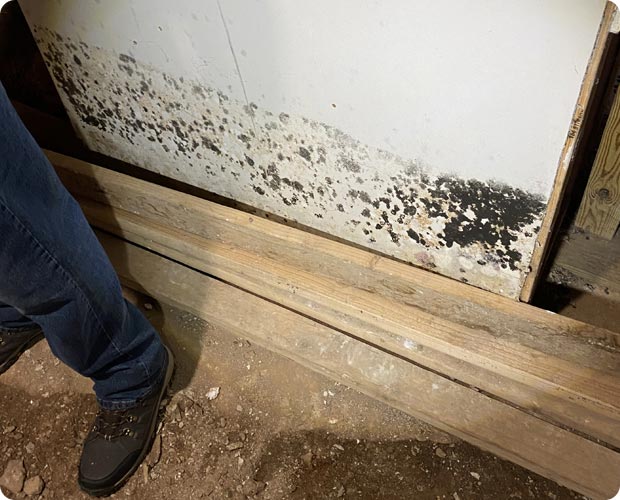
- Slimy black or dark greenish-black growth, typically on wet drywall, wood framing, or paper-faced materials
- A history of chronic wetness — a slow leak behind a wall, or a flood/flood-adjacent event that wasn't fully dried within days
- A musty odor without obvious visible growth (surface sampling may be needed to confirm)
- Chaetomium co-occurring — a brown-to-olive-black species that frequently appears alongside Stachybotrys after prolonged wetting, and is itself a strong indicator of a long-standing moisture problem
How we handle black mold removal in Jersey City
'Black mold' is a term used loosely for anything dark and alarming, but in remediation it specifically means Stachybotrys chartarum — slimy, black to dark greenish-black, and slow to establish: it typically takes 8-12 days of sustained wet conditions on cellulose material (drywall paper is ideal) to take hold. That slow timeline is actually useful context: Stachybotrys usually signals a chronic, undetected leak or a flood that wasn't dried out fast enough, not a one-day event.
The 'toxic mold' framing overstates some things and understates others. Stachybotrys does produce trichothecene mycotoxins, and it does warrant professional remediation — that concern is legitimate. But whether it causes illness in a given household depends on mycotoxin concentration, exposure duration, and individual sensitivity, which are questions for a physician or certified industrial hygienist, not a remediation contractor.