
Black mold removal in Roland Park: what to know
Roland Park is one of Baltimore's earliest planned suburbs, with large detached homes from the 1890s–1920s on heavily wooded lots — organic leaf litter accumulates against foundations, increasing moisture infiltration and mold risk.
Many Roland Park homes have original slate roofs and aging copper gutters — gutter failures and roof penetration leaks are common moisture sources for attic and wall mold.
Mold conditions in Roland Park
Common mold types in this area: Cladosporium (attic and exterior wood); Aspergillus (basement and crawl spaces); Stachybotrys (attic from ice dam or gutter failure).
We serve Roland Park Country School, Stony Run Trail, Roland Park Shopping Center, Gilman School (nearby) and the wider Roland Park area across ZIP codes 21210.
Signs you need black mold removal
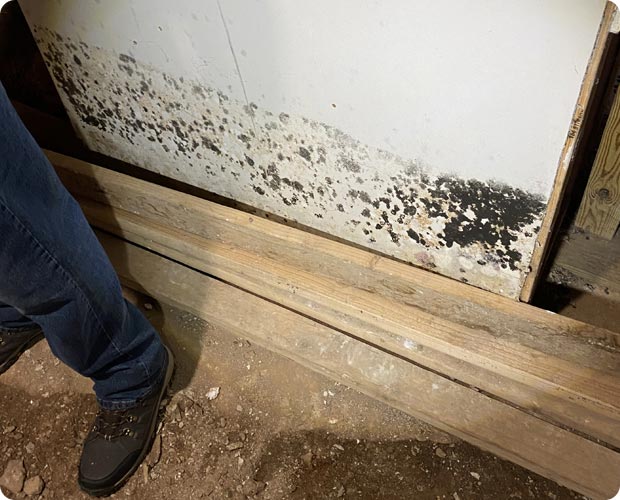
- Slimy black or dark greenish-black growth, typically on wet drywall, wood framing, or paper-faced materials
- A history of chronic wetness — a slow leak behind a wall, or a flood/flood-adjacent event that wasn't fully dried within days
- A musty odor without obvious visible growth (surface sampling may be needed to confirm)
- Chaetomium co-occurring — a brown-to-olive-black species that frequently appears alongside Stachybotrys after prolonged wetting, and is itself a strong indicator of a long-standing moisture problem
How we handle black mold removal in Roland Park
'Black mold' is a term used loosely for anything dark and alarming, but in remediation it specifically means Stachybotrys chartarum — slimy, black to dark greenish-black, and slow to establish: it typically takes 8-12 days of sustained wet conditions on cellulose material (drywall paper is ideal) to take hold. That slow timeline is actually useful context: Stachybotrys usually signals a chronic, undetected leak or a flood that wasn't dried out fast enough, not a one-day event.
The 'toxic mold' framing overstates some things and understates others. Stachybotrys does produce trichothecene mycotoxins, and it does warrant professional remediation — that concern is legitimate. But whether it causes illness in a given household depends on mycotoxin concentration, exposure duration, and individual sensitivity, which are questions for a physician or certified industrial hygienist, not a remediation contractor.