
Black mold removal in Shaw: what to know
If you're in a Shaw rowhouse, you're in one of DC's most historically significant Black neighbourhoods, with homes mostly built from the 1880s through the 1900s on the same party-wall, no-waterproofing-membrane construction seen across the city's older core. In parts of Shaw, decades of deferred maintenance mean some foundations are only now getting their first real look — so a moisture problem surfacing now isn't a sign you've done anything wrong.
Shaw has seen heavy new construction and renovation over the past 15 years, and a lot of it involves digging out basements to add square footage. If your neighbour is doing that kind of excavation next to a 130-year-old shared foundation wall, it can open new water paths into your side, even though the work isn't happening on your property at all.
Like Logan Circle and Shaw's other combined-sewer-era neighbours, a hard summer storm can push contaminated (Category 3) water into your basement, not just rain — it's a real and recurring pattern here, not a rare event.
Mold conditions in Shaw
Common mold types in this area: Stachybotrys chartarum (deferred-maintenance foundations with chronic seepage); Chaetomium (older masonry and framing with long-standing moisture); Penicillium/Aspergillus (basement excavation/renovation-disturbed party walls); Cladosporium (general background growth in humid summer conditions).
We serve Shaw/Howard University Metro, Blagden Alley, Howard Theatre, Convention Center, 9:30 Club (nearby) and the wider Shaw area across ZIP codes 20001.
Signs you need black mold removal
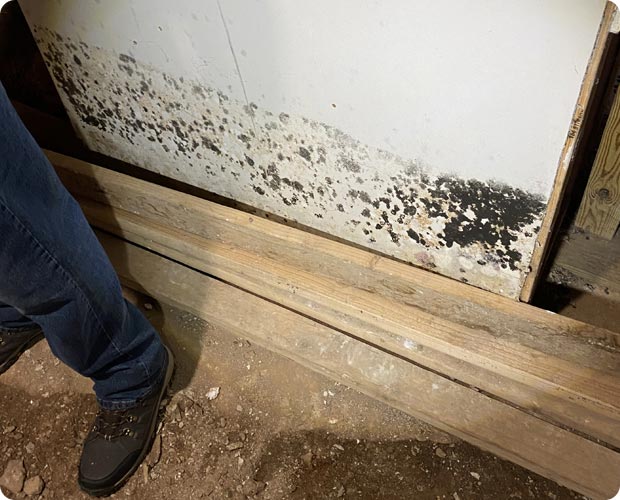
- Slimy black or dark greenish-black growth, typically on wet drywall, wood framing, or paper-faced materials
- A history of chronic wetness — a slow leak behind a wall, or a flood/flood-adjacent event that wasn't fully dried within days
- A musty odor without obvious visible growth (surface sampling may be needed to confirm)
- Chaetomium co-occurring — a brown-to-olive-black species that frequently appears alongside Stachybotrys after prolonged wetting, and is itself a strong indicator of a long-standing moisture problem
How we handle black mold removal in Shaw
'Black mold' is a term used loosely for anything dark and alarming, but in remediation it specifically means Stachybotrys chartarum — slimy, black to dark greenish-black, and slow to establish: it typically takes 8-12 days of sustained wet conditions on cellulose material (drywall paper is ideal) to take hold. That slow timeline is actually useful context: Stachybotrys usually signals a chronic, undetected leak or a flood that wasn't dried out fast enough, not a one-day event.
The 'toxic mold' framing overstates some things and understates others. Stachybotrys does produce trichothecene mycotoxins, and it does warrant professional remediation — that concern is legitimate. But whether it causes illness in a given household depends on mycotoxin concentration, exposure duration, and individual sensitivity, which are questions for a physician or certified industrial hygienist, not a remediation contractor.