
Skip to content
Licensed mold remediation — call to schedule
ES
MoldAct logo MoldAct IICRC S520 Certified Mold Remediation
Crew in hazmat suits sanitizing a surface affected by black mold growth

Black Mold Removal in NoMa, DC

'Black mold' almost always means Stachybotrys chartarum — a slow-growing species (8-12 days under sustained wet conditions) that needs chronically wet cellulose material like drywall paper, and produces mycotoxins. It requires full S520 remediation — independent assessment, containment, physical removal, and independent clearance — never a bleach-and-seal shortcut, and it's treated as Condition 3 regardless of job size.

Get Your Free Mold Inspection

Or call now: (877) 660-0430

Black mold removal in NoMa: what to know

If you live in NoMa (North of Massachusetts Avenue), you're almost certainly in new construction — most of these glass-and-steel towers were built from the mid-2000s onward on former rail-yard and industrial land. That means your mold risk looks nothing like DC's historic rowhouse core: it's HVAC condensate and building-envelope water intrusion, not old masonry.

A high-rise concentrates risk differently than a rowhouse does — a single roof membrane failure, a parking-garage waterproofing gap, or a shared mechanical-room leak can affect dozens of units through a shared wall or ceiling cavity before anyone traces it back. If you're smelling something with no obvious source in your own unit, it may not be your unit at all.

If your building sits on reclaimed industrial or rail land, which a fair amount of NoMa does, below-grade parking structures here have a documented history of groundwater intrusion that property managers keep a close eye on — worth asking about if you park or store anything below grade.

Mold conditions in NoMa

Common mold types in this area: Penicillium/Aspergillus (HVAC condensate failures in large multi-unit buildings); Cladosporium (below-grade parking structures with groundwater intrusion); Stachybotrys chartarum (undetected shared-wall leaks in high-rise construction); Chaetomium (rare in new construction, but seen where a leak has gone undetected for months).

We serve Union Station, NoMa-Gallaudet Metro, Gallaudet University, Metropolitan Branch Trail, REI Flagship Store and the wider NoMa area across ZIP codes 20002.

Signs you need black mold removal

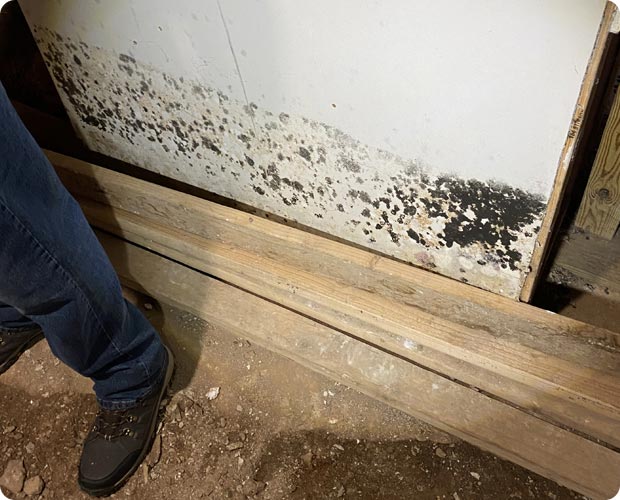
  • Slimy black or dark greenish-black growth, typically on wet drywall, wood framing, or paper-faced materials
  • A history of chronic wetness — a slow leak behind a wall, or a flood/flood-adjacent event that wasn't fully dried within days
  • A musty odor without obvious visible growth (surface sampling may be needed to confirm)
  • Chaetomium co-occurring — a brown-to-olive-black species that frequently appears alongside Stachybotrys after prolonged wetting, and is itself a strong indicator of a long-standing moisture problem

How we handle black mold removal in NoMa

'Black mold' is a term used loosely for anything dark and alarming, but in remediation it specifically means Stachybotrys chartarum — slimy, black to dark greenish-black, and slow to establish: it typically takes 8-12 days of sustained wet conditions on cellulose material (drywall paper is ideal) to take hold. That slow timeline is actually useful context: Stachybotrys usually signals a chronic, undetected leak or a flood that wasn't dried out fast enough, not a one-day event.

The 'toxic mold' framing overstates some things and understates others. Stachybotrys does produce trichothecene mycotoxins, and it does warrant professional remediation — that concern is legitimate. But whether it causes illness in a given household depends on mycotoxin concentration, exposure duration, and individual sensitivity, which are questions for a physician or certified industrial hygienist, not a remediation contractor.

Simple, transparent process

Our NoMa Black Mold Removal Process

  1. 1

    Independent assessment first

    Because Stachybotrys under-reports on air sampling, a qualified assessor adds surface sampling when it's suspected, and writes the protocol before any remediation begins.

  2. 2

    Full containment regardless of size

    Stachybotrys jobs are treated as Condition 3 — floor-to-ceiling poly containment with a HEPA air scrubber running negative pressure — even for a small affected area.

  3. 3

    Full-face respirator protocol

    P100/OV cartridge respirators (half-face minimum), Tyvek coveralls, and gloves are used for the duration of the job, reflecting the Condition 3 classification.

  4. 4

    Physical removal

    Contaminated porous material is removed and double-bagged in poly before leaving containment — Stachybotrys is never sprayed and left in place.

  5. 5

    Independent clearance testing

    A separate assessor confirms clearance — no visible growth, no musty odor, and indoor spore counts at or below the outdoor control — before the area is opened back up.

Black Mold Removal in NoMa — FAQs

Do you provide black mold removal in NoMa?

Yes — MoldAct provides black mold removal throughout NoMa, DC (ZIP codes: 20002) and surrounding Washington DC areas. Call us to book the earliest available appointment.

Is all black mold Stachybotrys?

No — several species can appear dark or black. Confirming the species requires sampling; assuming based on colour alone isn't reliable, which is one reason an independent inspection matters before remediation starts.

Is Stachybotrys as dangerous as I've read online?

It does produce mycotoxins and does warrant professional remediation — that part is legitimate. Whether it causes illness in your specific situation depends on concentration, exposure duration, and individual sensitivity — those are questions for a physician or certified industrial hygienist, not something a contractor should diagnose.

Why didn't air sampling pick up mold I can see on the wall?

Stachybotrys spores are heavy and sticky and often don't become airborne unless disturbed, so they can be under-represented or absent in air samples even when visible on a surface. That's exactly why surface sampling is used when this species is suspected.

Can I just bleach it myself?

Bleach doesn't penetrate porous material like wood framing or drywall paper — it can lighten surface staining while leaving the underlying growth and adding moisture. Confirmed Stachybotrys needs physical removal under containment, not a bleach treatment.

Black Mold Removal in NoMa — book today

Licensed, insured mold remediation contractors. Call to schedule.

Call Now Free Quote