
Black mold removal in Ashburn: what to know
If you're in Ashburn, you're almost certainly in newer construction — most of the area was farmland until the 1990s and 2000s, when it became one of the fastest-growing suburbs in the country, now globally known as the heart of 'Data Center Alley.' Newer construction generally means better foundation waterproofing than older Northern Virginia towns, but it isn't immune to the same HVAC and grading issues every mid-Atlantic suburb deals with.
Ashburn's rapid, dense development over a relatively short window means stormwater management ponds and engineered drainage are common features of newer subdivisions here — when they're properly maintained, basement moisture is genuinely less common than in older towns; when a pond or swale is neglected, it can concentrate runoff toward specific properties instead of dispersing it as designed.
The sheer density of new construction and ongoing development in Ashburn means a new-construction dig near an established property can occasionally disrupt drainage patterns that had kept a neighbouring foundation dry — worth asking about if a moisture problem shows up shortly after nearby construction starts.
Mold conditions in Ashburn
Common mold types in this area: Cladosporium (general background growth in newer suburban construction); Penicillium/Aspergillus (HVAC condensate issues common to newer mid-Atlantic suburbs); Stachybotrys chartarum (concentrated runoff from neglected stormwater management features); Chaetomium (drainage disruption from adjacent new-construction activity).
We serve Data Center Alley, One Loudoun, Ashburn Village, W&OD Trail, Brambleton (nearby) and the wider Ashburn area across ZIP codes 20147, 20148.
Signs you need black mold removal
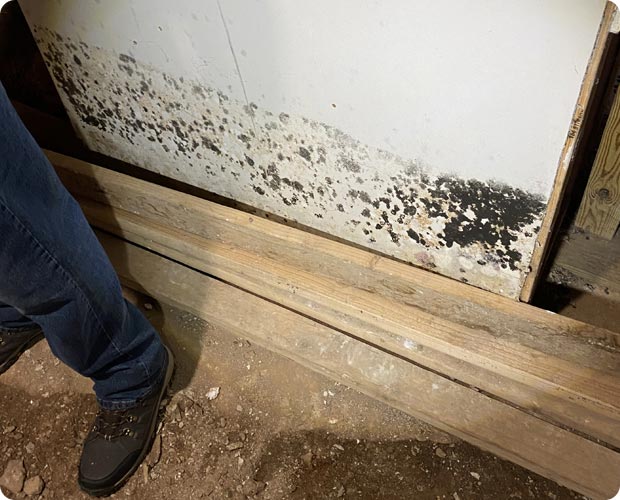
- Slimy black or dark greenish-black growth, typically on wet drywall, wood framing, or paper-faced materials
- A history of chronic wetness — a slow leak behind a wall, or a flood/flood-adjacent event that wasn't fully dried within days
- A musty odor without obvious visible growth (surface sampling may be needed to confirm)
- Chaetomium co-occurring — a brown-to-olive-black species that frequently appears alongside Stachybotrys after prolonged wetting, and is itself a strong indicator of a long-standing moisture problem
How we handle black mold removal in Ashburn
'Black mold' is a term used loosely for anything dark and alarming, but in remediation it specifically means Stachybotrys chartarum — slimy, black to dark greenish-black, and slow to establish: it typically takes 8-12 days of sustained wet conditions on cellulose material (drywall paper is ideal) to take hold. That slow timeline is actually useful context: Stachybotrys usually signals a chronic, undetected leak or a flood that wasn't dried out fast enough, not a one-day event.
The 'toxic mold' framing overstates some things and understates others. Stachybotrys does produce trichothecene mycotoxins, and it does warrant professional remediation — that concern is legitimate. But whether it causes illness in a given household depends on mycotoxin concentration, exposure duration, and individual sensitivity, which are questions for a physician or certified industrial hygienist, not a remediation contractor.