
Black mold removal in Foggy Bottom: what to know
Foggy Bottom takes its name from the low-lying, once-marshy ground along the Potomac that historically trapped fog and industrial smoke — if you're here, that same low, damp terrain means groundwater and foundation moisture have always been more persistent for you than for DC's higher-elevation neighbourhoods.
If your rowhouse sits next to one of the big institutions here — GWU, the State Department, the World Bank — their large centralised HVAC systems can develop condensate or drain-pan failures that spread moisture into your adjacent party wall, even though the fault is entirely on their side of it.
If you rent a basement or ground-floor unit near GWU, know that dense student turnover means moisture issues here often go unreported for a full leasing cycle before anyone who can act on it actually hears about it.
Mold conditions in Foggy Bottom
Common mold types in this area: Cladosporium (low-lying, historically marshy ground and its effect on foundation moisture); Penicillium/Aspergillus (institutional HVAC systems adjacent to residential party walls); Stachybotrys chartarum (student-rental units with delayed leak reporting); Chaetomium (older rowhouse basements with chronic groundwater proximity).
We serve George Washington University, Kennedy Center, U.S. Department of State, World Bank, Rock Creek Trail and the wider Foggy Bottom area across ZIP codes 20037.
Signs you need black mold removal
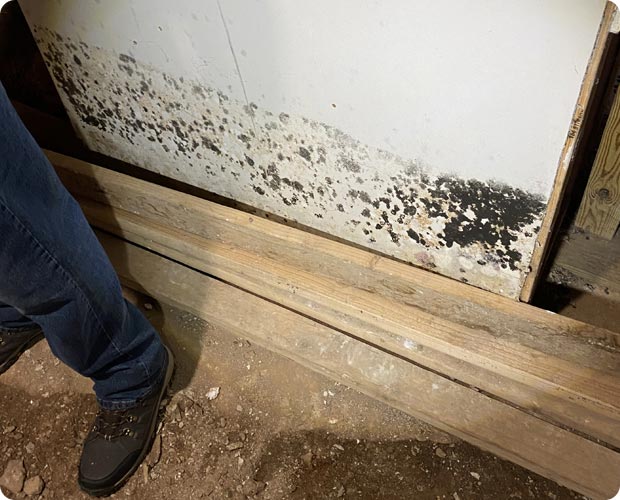
- Slimy black or dark greenish-black growth, typically on wet drywall, wood framing, or paper-faced materials
- A history of chronic wetness — a slow leak behind a wall, or a flood/flood-adjacent event that wasn't fully dried within days
- A musty odor without obvious visible growth (surface sampling may be needed to confirm)
- Chaetomium co-occurring — a brown-to-olive-black species that frequently appears alongside Stachybotrys after prolonged wetting, and is itself a strong indicator of a long-standing moisture problem
How we handle black mold removal in Foggy Bottom
'Black mold' is a term used loosely for anything dark and alarming, but in remediation it specifically means Stachybotrys chartarum — slimy, black to dark greenish-black, and slow to establish: it typically takes 8-12 days of sustained wet conditions on cellulose material (drywall paper is ideal) to take hold. That slow timeline is actually useful context: Stachybotrys usually signals a chronic, undetected leak or a flood that wasn't dried out fast enough, not a one-day event.
The 'toxic mold' framing overstates some things and understates others. Stachybotrys does produce trichothecene mycotoxins, and it does warrant professional remediation — that concern is legitimate. But whether it causes illness in a given household depends on mycotoxin concentration, exposure duration, and individual sensitivity, which are questions for a physician or certified industrial hygienist, not a remediation contractor.