
Black mold removal in Arlington: what to know
If you're in Arlington, know first that you're in Virginia, not DC — a different state and a different legal jurisdiction, with mold disclosure and remediation rules that aren't the same as the District's. Anything written specifically for DC doesn't automatically apply to you just because you're a bridge away.
If you're in the Rosslyn-Ballston corridor, you're likely in dense, newer high-rise construction where HVAC condensate and building-envelope water intrusion are the dominant risks. If you're in one of Arlington's older single-family neighbourhoods from the 1940s–1960s post-war boom instead, your crawl space or basement behaves much more like Maryland or DC's older housing stock.
You're along the Potomac and several of its tributary streams here, Four Mile Run among them — if you're on a low-lying block near one of those waterways, stormwater and groundwater intrusion after a heavy regional storm is a documented risk for you, not a hypothetical one.
Mold conditions in Arlington
Common mold types in this area: Penicillium/Aspergillus (HVAC condensate issues in Rosslyn-Ballston high-rise construction); Cladosporium (crawl spaces in 1940s–1960s post-war single-family housing); Stachybotrys chartarum (chronic basement moisture near Four Mile Run and other low-lying areas); Chaetomium (older homes with long-standing, undetected leaks).
We serve Rosslyn-Ballston corridor, Arlington National Cemetery, The Pentagon, Clarendon, Four Mile Run and the wider Arlington area across ZIP codes 22201, 22203, 22204, 22206, 22209.
Signs you need black mold removal
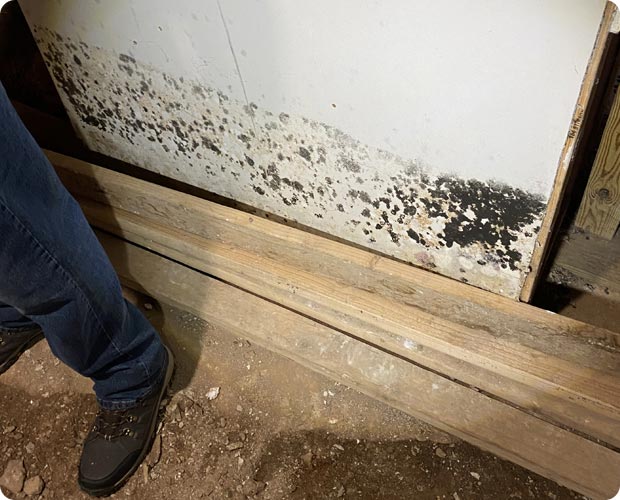
- Slimy black or dark greenish-black growth, typically on wet drywall, wood framing, or paper-faced materials
- A history of chronic wetness — a slow leak behind a wall, or a flood/flood-adjacent event that wasn't fully dried within days
- A musty odor without obvious visible growth (surface sampling may be needed to confirm)
- Chaetomium co-occurring — a brown-to-olive-black species that frequently appears alongside Stachybotrys after prolonged wetting, and is itself a strong indicator of a long-standing moisture problem
How we handle black mold removal in Arlington
'Black mold' is a term used loosely for anything dark and alarming, but in remediation it specifically means Stachybotrys chartarum — slimy, black to dark greenish-black, and slow to establish: it typically takes 8-12 days of sustained wet conditions on cellulose material (drywall paper is ideal) to take hold. That slow timeline is actually useful context: Stachybotrys usually signals a chronic, undetected leak or a flood that wasn't dried out fast enough, not a one-day event.
The 'toxic mold' framing overstates some things and understates others. Stachybotrys does produce trichothecene mycotoxins, and it does warrant professional remediation — that concern is legitimate. But whether it causes illness in a given household depends on mycotoxin concentration, exposure duration, and individual sensitivity, which are questions for a physician or certified industrial hygienist, not a remediation contractor.