
Black mold removal in Severna Park: what to know
If you're on the water in Severna Park — and a lot of the community sits along the Severn River and the Chesapeake Bay's many inlets — waterfront and near-waterfront homes here carry a genuinely higher groundwater and tidal-influence risk than the inland parts of Anne Arundel County.
A lot of Severna Park's housing runs from older waterfront cottages, some dating back to the early 20th century as summer retreats before year-round living took over, through to newer suburban construction further from the shoreline — the older cottages in particular often have minimal or no foundation waterproofing at all.
The Chesapeake Bay's humid climate keeps summer humidity high here much like the rest of the mid-Atlantic, and salt-air exposure near the water accelerates the kind of building envelope wear — window seals, exterior trim — that lets moisture in over time.
Mold conditions in Severna Park
Common mold types in this area: Cladosporium (salt-air-accelerated building envelope wear near the water); Stachybotrys chartarum (older waterfront cottages with minimal or no foundation waterproofing); Penicillium/Aspergillus (newer suburban HVAC and interior humidity); Chaetomium (chronic moisture in early-20th-century summer-cottage-turned-year-round homes).
We serve Severn River, Kinder Farm Park, Jones Station Park, Downs Park (nearby), B&A Trail and the wider Severna Park area across ZIP codes 21146.
Signs you need black mold removal
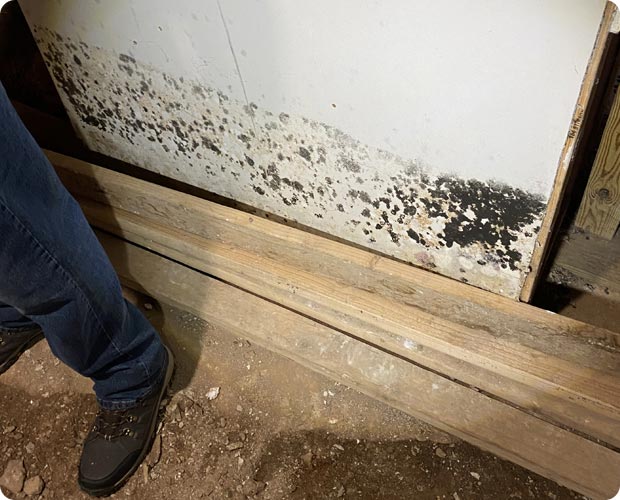
- Slimy black or dark greenish-black growth, typically on wet drywall, wood framing, or paper-faced materials
- A history of chronic wetness — a slow leak behind a wall, or a flood/flood-adjacent event that wasn't fully dried within days
- A musty odor without obvious visible growth (surface sampling may be needed to confirm)
- Chaetomium co-occurring — a brown-to-olive-black species that frequently appears alongside Stachybotrys after prolonged wetting, and is itself a strong indicator of a long-standing moisture problem
How we handle black mold removal in Severna Park
'Black mold' is a term used loosely for anything dark and alarming, but in remediation it specifically means Stachybotrys chartarum — slimy, black to dark greenish-black, and slow to establish: it typically takes 8-12 days of sustained wet conditions on cellulose material (drywall paper is ideal) to take hold. That slow timeline is actually useful context: Stachybotrys usually signals a chronic, undetected leak or a flood that wasn't dried out fast enough, not a one-day event.
The 'toxic mold' framing overstates some things and understates others. Stachybotrys does produce trichothecene mycotoxins, and it does warrant professional remediation — that concern is legitimate. But whether it causes illness in a given household depends on mycotoxin concentration, exposure duration, and individual sensitivity, which are questions for a physician or certified industrial hygienist, not a remediation contractor.