
Mold testing in Shaw: what to know
If you're in a Shaw rowhouse, you're in one of DC's most historically significant Black neighbourhoods, with homes mostly built from the 1880s through the 1900s on the same party-wall, no-waterproofing-membrane construction seen across the city's older core. In parts of Shaw, decades of deferred maintenance mean some foundations are only now getting their first real look — so a moisture problem surfacing now isn't a sign you've done anything wrong.
Shaw has seen heavy new construction and renovation over the past 15 years, and a lot of it involves digging out basements to add square footage. If your neighbour is doing that kind of excavation next to a 130-year-old shared foundation wall, it can open new water paths into your side, even though the work isn't happening on your property at all.
Like Logan Circle and Shaw's other combined-sewer-era neighbours, a hard summer storm can push contaminated (Category 3) water into your basement, not just rain — it's a real and recurring pattern here, not a rare event.
Mold conditions in Shaw
Common mold types in this area: Stachybotrys chartarum (deferred-maintenance foundations with chronic seepage); Chaetomium (older masonry and framing with long-standing moisture); Penicillium/Aspergillus (basement excavation/renovation-disturbed party walls); Cladosporium (general background growth in humid summer conditions).
We serve Shaw/Howard University Metro, Blagden Alley, Howard Theatre, Convention Center, 9:30 Club (nearby) and the wider Shaw area across ZIP codes 20001.
Signs you need mold testing
- Unexplained musty odour with no visible mold
- Health symptoms that improve when occupants leave the building
- Post-remediation verification that work was completed successfully
- Pre-purchase due diligence on a home or commercial property
- Landlord-tenant dispute requiring independent third-party documentation
- Insurance claim requiring laboratory evidence of mold type and extent
How we handle mold testing in Shaw
Mold testing is not the same as a mold inspection. Testing refers specifically to the collection and laboratory analysis of air or surface samples to identify mold species and quantify spore concentrations. An inspection includes testing but also includes a visual survey, moisture mapping, and a written remediation protocol. Testing alone — without the inspection context — can produce data that is difficult to interpret correctly.
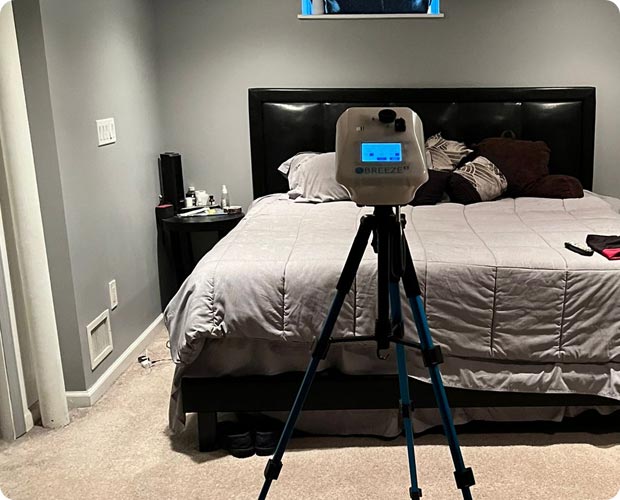
Air sampling for mold uses impaction cassettes (Air-O-Cell, Zefon BioPump) that capture particles from a calibrated air volume onto a collection medium. The cassette is analysed by a qualified analyst under microscopy. Results are reported as spores per cubic metre for each species identified. Critically, indoor samples must always be compared to an outdoor control sample taken simultaneously — outdoor spore counts vary by season, weather, and location.