
Mold testing in Washington: what to know
If you live in one of DC's classic rowhouses — the kind that lines Shaw, LeDroit Park, Logan Circle, Dupont, and so many other neighbourhoods here — you already know your home shares walls with the ones on either side of it. That's part of what makes DC feel like DC. It also means moisture doesn't always respect a property line: a party wall built before modern waterproofing existed can carry dampness from a neighbour's foundation issue into yours, and most of this housing stock predates any waterproofing membrane at all. So if you've never had a moisture problem yourself but suddenly have one, it's not always something you did — it's often just old masonry doing what old masonry does.
A lot of DC rowhouses also have an English basement — a partially below-grade unit that's below the main house but still gets a window and a door to the street. They're a genuinely nice piece of DC housing, whether it's your guest space, your rental income, or where you actually live. They're also, structurally, the part of the house closest to the ground and furthest from fresh air circulation, which makes them the first place moisture shows up. If you rent or live in one and you've noticed a musty smell or a soft patch on a wall, you're not imagining it, and it's worth getting looked at early rather than waiting.
DC's summers are genuinely rough on a building — hot, muggy, with relative humidity regularly sitting above 65–70% from June through September. And the city's combined sewer system, which carries stormwater and sewage in the same pipes across a lot of the older parts of DC, means a hard summer storm can push water back up into basements as contaminated (Category 3) water — a different, more serious problem than a simple leak, and one that needs professional handling, not just a mop and a fan.
It's not just houses, either. A good share of downtown DC's office and mixed-use buildings run one centralised HVAC system across several floors, so a single coil or drain-pan failure can quietly spread moisture into more than one office or unit before anyone notices the smell. If that's you, you're not being paranoid to want it checked — a shared system means a shared risk.
Mold conditions in Washington
Common mold types in this area: Cladosporium (the everyday background species — shows up on window sills, trim, and basement surfaces wherever there's been sustained moisture); Penicillium/Aspergillus (common in rowhouse basements, English basements, and HVAC-served office space with chronic dampness); Stachybotrys chartarum ('black mold' — needs sustained wet conditions, so it points to a chronic leak or an under-dried sewer backup, not a one-day event); Chaetomium (a strong sign of a long-standing moisture problem, often found alongside Stachybotrys in water-damaged drywall and plaster).
We serve The National Mall, U.S. Capitol, The White House, Smithsonian National Museum of Natural History, Dupont Circle and the wider Washington area across ZIP codes 20005, 20001, 20009, 20036, 20037.
Signs you need mold testing
- Unexplained musty odour with no visible mold
- Health symptoms that improve when occupants leave the building
- Post-remediation verification that work was completed successfully
- Pre-purchase due diligence on a home or commercial property
- Landlord-tenant dispute requiring independent third-party documentation
- Insurance claim requiring laboratory evidence of mold type and extent
How we handle mold testing in Washington
Mold testing is not the same as a mold inspection. Testing refers specifically to the collection and laboratory analysis of air or surface samples to identify mold species and quantify spore concentrations. An inspection includes testing but also includes a visual survey, moisture mapping, and a written remediation protocol. Testing alone — without the inspection context — can produce data that is difficult to interpret correctly.
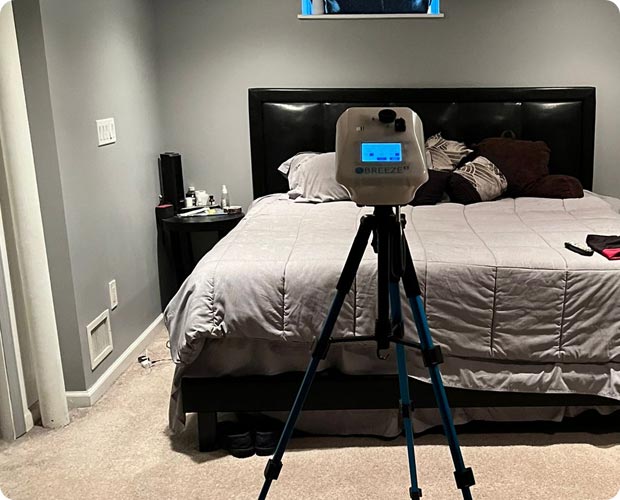
Air sampling for mold uses impaction cassettes (Air-O-Cell, Zefon BioPump) that capture particles from a calibrated air volume onto a collection medium. The cassette is analysed by a qualified analyst under microscopy. Results are reported as spores per cubic metre for each species identified. Critically, indoor samples must always be compared to an outdoor control sample taken simultaneously — outdoor spore counts vary by season, weather, and location.