
Mold testing in Columbia Heights: what to know
Columbia Heights was rebuilt densely in the early 1900s with rowhouses and mid-rise apartment buildings packed close together — if your building's roof or gutters fail, that water can go straight into the party wall of the place next door, not just your own.
If your block saw new construction during the 2000s redevelopment wave, know that a new-construction basement dug into a row of century-old party walls can disrupt drainage patterns that had quietly kept older neighbouring foundations dry for decades — sometimes that's exactly why a long-dry basement suddenly isn't.
You're on DC's older combined sewer system here like much of the historic core, so a hard summer storm can push Category 3 water into your basement — a documented pattern in this neighbourhood, not a one-off.
Mold conditions in Columbia Heights
Common mold types in this area: Chaetomium (party-wall moisture transfer between densely packed rowhouses); Stachybotrys chartarum (drainage disruption from new-construction basement digs); Penicillium/Aspergillus (mid-rise apartment plumbing stacks); Cladosporium (general background growth, humid summer months).
We serve DC USA / 14th Street retail corridor, Tivoli Theatre, Meridian Hill Park, Columbia Heights Metro, Banneker Recreation Center and the wider Columbia Heights area across ZIP codes 20010, 20009.
Signs you need mold testing
- Unexplained musty odour with no visible mold
- Health symptoms that improve when occupants leave the building
- Post-remediation verification that work was completed successfully
- Pre-purchase due diligence on a home or commercial property
- Landlord-tenant dispute requiring independent third-party documentation
- Insurance claim requiring laboratory evidence of mold type and extent
How we handle mold testing in Columbia Heights
Mold testing is not the same as a mold inspection. Testing refers specifically to the collection and laboratory analysis of air or surface samples to identify mold species and quantify spore concentrations. An inspection includes testing but also includes a visual survey, moisture mapping, and a written remediation protocol. Testing alone — without the inspection context — can produce data that is difficult to interpret correctly.
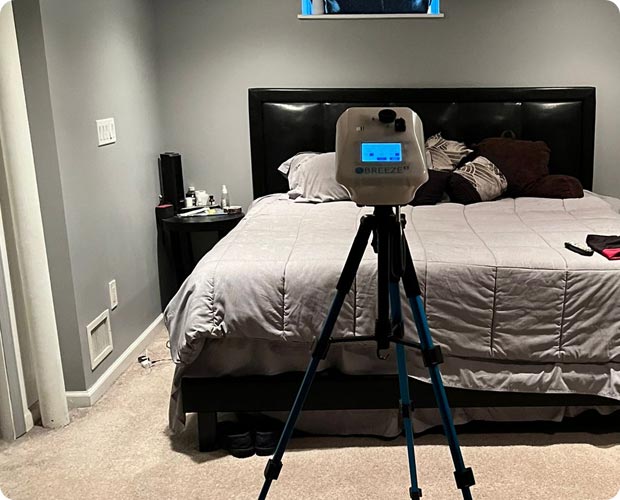
Air sampling for mold uses impaction cassettes (Air-O-Cell, Zefon BioPump) that capture particles from a calibrated air volume onto a collection medium. The cassette is analysed by a qualified analyst under microscopy. Results are reported as spores per cubic metre for each species identified. Critically, indoor samples must always be compared to an outdoor control sample taken simultaneously — outdoor spore counts vary by season, weather, and location.