
Skip to content
Licensed mold remediation — call to schedule
ES
MoldAct logo MoldAct IICRC S520 Certified Mold Remediation
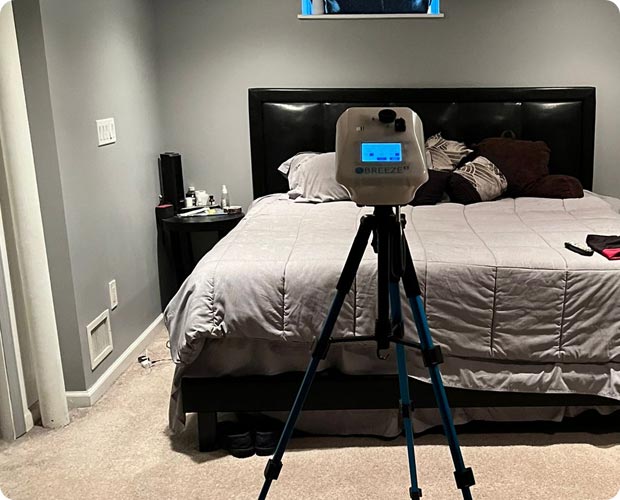
Indoor air quality technician collecting a mold air sample with a spore trap device

Mold Testing & Air Quality in NoMa, DC

Professional mold testing includes paired indoor/outdoor air cassette sampling, surface samples for Stachybotrys and Chaetomium, analysis at an AIHA-accredited laboratory, and a written report with species identification, spore counts, and interpretation — distinguishing elevated indoor levels from normal background.

Get Your Free Mold Inspection

Or call now: (877) 660-0430

Mold testing in NoMa: what to know

If you live in NoMa (North of Massachusetts Avenue), you're almost certainly in new construction — most of these glass-and-steel towers were built from the mid-2000s onward on former rail-yard and industrial land. That means your mold risk looks nothing like DC's historic rowhouse core: it's HVAC condensate and building-envelope water intrusion, not old masonry.

A high-rise concentrates risk differently than a rowhouse does — a single roof membrane failure, a parking-garage waterproofing gap, or a shared mechanical-room leak can affect dozens of units through a shared wall or ceiling cavity before anyone traces it back. If you're smelling something with no obvious source in your own unit, it may not be your unit at all.

If your building sits on reclaimed industrial or rail land, which a fair amount of NoMa does, below-grade parking structures here have a documented history of groundwater intrusion that property managers keep a close eye on — worth asking about if you park or store anything below grade.

Mold conditions in NoMa

Common mold types in this area: Penicillium/Aspergillus (HVAC condensate failures in large multi-unit buildings); Cladosporium (below-grade parking structures with groundwater intrusion); Stachybotrys chartarum (undetected shared-wall leaks in high-rise construction); Chaetomium (rare in new construction, but seen where a leak has gone undetected for months).

We serve Union Station, NoMa-Gallaudet Metro, Gallaudet University, Metropolitan Branch Trail, REI Flagship Store and the wider NoMa area across ZIP codes 20002.

Signs you need mold testing

  • Unexplained musty odour with no visible mold
  • Health symptoms that improve when occupants leave the building
  • Post-remediation verification that work was completed successfully
  • Pre-purchase due diligence on a home or commercial property
  • Landlord-tenant dispute requiring independent third-party documentation
  • Insurance claim requiring laboratory evidence of mold type and extent

How we handle mold testing in NoMa

Mold testing is not the same as a mold inspection. Testing refers specifically to the collection and laboratory analysis of air or surface samples to identify mold species and quantify spore concentrations. An inspection includes testing but also includes a visual survey, moisture mapping, and a written remediation protocol. Testing alone — without the inspection context — can produce data that is difficult to interpret correctly.

Air sampling for mold uses impaction cassettes (Air-O-Cell, Zefon BioPump) that capture particles from a calibrated air volume onto a collection medium. The cassette is analysed by a qualified analyst under microscopy. Results are reported as spores per cubic metre for each species identified. Critically, indoor samples must always be compared to an outdoor control sample taken simultaneously — outdoor spore counts vary by season, weather, and location.

Simple, transparent process

Our NoMa Mold Testing & Air Quality Process

  1. 1

    Sample strategy planning

    The assessor determines the number and location of samples based on the property size, symptom reports, and visible moisture indicators. At minimum, one outdoor control sample is collected simultaneously with every indoor sample.

  2. 2

    Air sampling

    Air cassettes are operated at a calibrated flow rate (typically 15 L/min) for a fixed volume (usually 75–150 litres). Samples are collected in areas of concern and in unaffected areas for comparison.

  3. 3

    Surface sampling

    Tape-lift samples are taken from visible mold growth for species identification. Swab samples are taken from irregular or wet surfaces. Bulk samples (material pieces) may be taken from heavily contaminated substrates for culture analysis.

  4. 4

    AIHA laboratory analysis

    All samples are chain-of-custody shipped to an AIHA-accredited laboratory. Standard turnaround is 3–5 business days; rush (24–48 hour) service is available. The lab report identifies all species detected and quantifies spore counts per cubic metre.

  5. 5

    Written interpretation report

    The licensed assessor interprets the laboratory data in the context of the property inspection findings, identifies elevated species, and provides a written report with conclusions and, if remediation is indicated, a protocol.

Mold Testing & Air Quality in NoMa — FAQs

Do you provide mold testing in NoMa?

Yes — MoldAct provides mold testing throughout NoMa, DC (ZIP codes: 20002) and surrounding Washington DC areas. Call us to book the earliest available appointment.

Are DIY mold test kits reliable?

DIY petri-dish and swab test kits sold at home improvement stores have very poor reliability. They detect almost anything that settles in the dish (including harmless outdoor molds), produce no quantitative data, and cannot tell you what is elevated compared to outdoor background. Professional AIHA-accredited laboratory analysis is the only defensible standard.

How many samples do I need?

At minimum, one indoor sample per area of concern plus one outdoor control. A standard residential assessment typically uses 3–6 samples. Properties with multiple suspect areas, post-remediation clearance, or legal disputes typically require more.

What is a 'normal' mold count?

There is no OSHA or EPA regulatory standard for indoor mold spore counts. The standard interpretation is that indoor species and concentrations should mirror outdoor background. Elevated indoor levels of any species not present outdoors, or indoor counts significantly higher than outdoor counts for the same species, indicate an indoor mold problem.

Mold Testing & Air Quality in NoMa — book today

Licensed, insured mold remediation contractors. Call to schedule.

Call Now Free Quote