
Mold testing in Navy Yard: what to know
If you're in Navy Yard, you're almost certainly in 2010s-era high-rise development along the Anacostia River waterfront — like NoMa, your relevant mold risks are building-envelope and HVAC-condensate issues in new construction, not old masonry.
Your building's riverfront elevation and proximity to the Anacostia mean below-grade parking and mechanical levels were built with flood-resilience measures in mind — but a below-grade space next to a tidal river is still a below-grade space next to a tidal river, and we take a sump-pump or drainage complaint here seriously, not as an overreaction.
If you run or work in ground-floor retail or a restaurant near Nationals Park, kitchen exhaust and grease-trap humidity are a real, commercial-specific mold driver distinct from what the residential floors above you deal with.
Mold conditions in Navy Yard
Common mold types in this area: Penicillium/Aspergillus (HVAC condensate failures in new high-rise towers); Cladosporium (ground-floor commercial kitchen humidity); Stachybotrys chartarum (sump-pump or drainage failures in riverfront below-grade levels); Chaetomium (rare in new construction, seen only where a leak went long undetected).
We serve Nationals Park, The Yards Park, Anacostia Riverwalk Trail, Navy Yard-Ballpark Metro, Audi Field (nearby) and the wider Navy Yard area across ZIP codes 20003, 20024.
Signs you need mold testing
- Unexplained musty odour with no visible mold
- Health symptoms that improve when occupants leave the building
- Post-remediation verification that work was completed successfully
- Pre-purchase due diligence on a home or commercial property
- Landlord-tenant dispute requiring independent third-party documentation
- Insurance claim requiring laboratory evidence of mold type and extent
How we handle mold testing in Navy Yard
Mold testing is not the same as a mold inspection. Testing refers specifically to the collection and laboratory analysis of air or surface samples to identify mold species and quantify spore concentrations. An inspection includes testing but also includes a visual survey, moisture mapping, and a written remediation protocol. Testing alone — without the inspection context — can produce data that is difficult to interpret correctly.
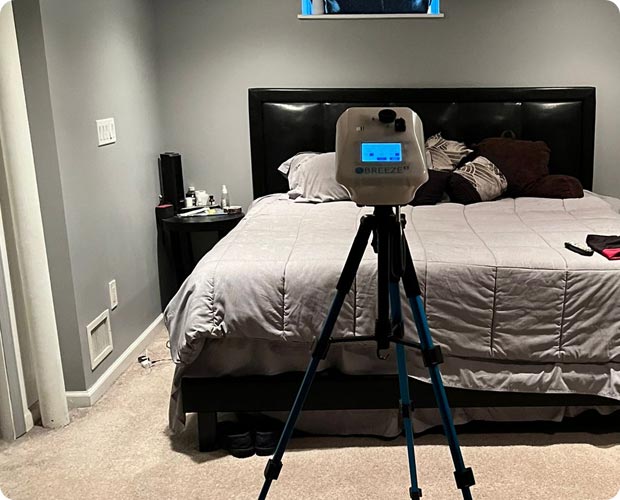
Air sampling for mold uses impaction cassettes (Air-O-Cell, Zefon BioPump) that capture particles from a calibrated air volume onto a collection medium. The cassette is analysed by a qualified analyst under microscopy. Results are reported as spores per cubic metre for each species identified. Critically, indoor samples must always be compared to an outdoor control sample taken simultaneously — outdoor spore counts vary by season, weather, and location.