
Bathroom mold removal in NoMa: what to know
If you live in NoMa (North of Massachusetts Avenue), you're almost certainly in new construction — most of these glass-and-steel towers were built from the mid-2000s onward on former rail-yard and industrial land. That means your mold risk looks nothing like DC's historic rowhouse core: it's HVAC condensate and building-envelope water intrusion, not old masonry.
A high-rise concentrates risk differently than a rowhouse does — a single roof membrane failure, a parking-garage waterproofing gap, or a shared mechanical-room leak can affect dozens of units through a shared wall or ceiling cavity before anyone traces it back. If you're smelling something with no obvious source in your own unit, it may not be your unit at all.
If your building sits on reclaimed industrial or rail land, which a fair amount of NoMa does, below-grade parking structures here have a documented history of groundwater intrusion that property managers keep a close eye on — worth asking about if you park or store anything below grade.
Mold conditions in NoMa
Common mold types in this area: Penicillium/Aspergillus (HVAC condensate failures in large multi-unit buildings); Cladosporium (below-grade parking structures with groundwater intrusion); Stachybotrys chartarum (undetected shared-wall leaks in high-rise construction); Chaetomium (rare in new construction, but seen where a leak has gone undetected for months).
We serve Union Station, NoMa-Gallaudet Metro, Gallaudet University, Metropolitan Branch Trail, REI Flagship Store and the wider NoMa area across ZIP codes 20002.
Signs you need bathroom mold removal
- Black or greenish mould visible on grout lines, caulk, or tile surfaces
- Soft or spongy drywall at the base of the shower or bath surround
- Bubbling, cracked, or loose tiles — often indicating moisture migration behind
- Persistent musty odour in the bathroom after surface cleaning
- Staining on the ceiling below a bathroom (mold in subfloor or hidden leak)
- Visible mold at the base of toilet, vanity, or around plumbing penetrations
How we handle bathroom mold removal in NoMa
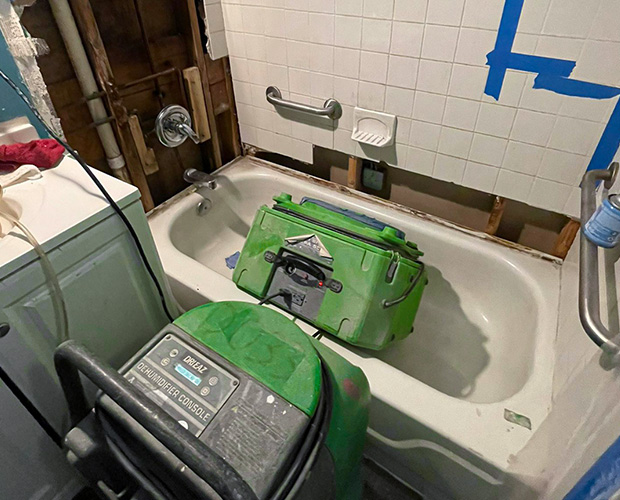
Bathroom mold is extremely common and ranges from minor surface growth on grout and caulk to serious structural mold growth behind tile, in wall cavities, and under subfloor decking. The difference matters enormously: surface mold on a non-porous substrate (glazed tile, sealed grout) can often be professionally cleaned without demolition; mold inside the wall cavity requires opening the wall, removing affected drywall and insulation, and following IICRC S520 protocol.
The most common bathroom moisture sources are: inadequate or non-functioning exhaust ventilation, grout and caulk failures that allow water into wall cavities, overflow from showers or tubs, and chronic toilet base leaks. In all cases, the moisture source must be corrected before any mold treatment — retiling over wet, contaminated drywall simply delays the problem.