
Mold testing in Mount Pleasant: what to know
If you're along Mount Pleasant Street, you're likely in a late-1800s Victorian rowhouse; set back on a landscaped courtyard, you're probably in an early-1900s garden apartment building. Those garden-apartment below-grade laundry and mechanical rooms are a common, often-overlooked source of building-wide humidity that residents don't always connect to their own unit's smell.
You're close to Rock Creek Park's ravine terrain here, and if you're on one of the lower, creek-adjacent blocks, groundwater intrusion is a documented, more pronounced risk than on the flatter blocks toward Columbia Heights.
If your Victorian rowhouse has a deep, narrow lot with limited side-yard drainage — common in Mount Pleasant — grading that channels roof runoff back toward your foundation instead of away from it is a common, fixable contributor to basement moisture, and it's worth having checked even before you see a problem.
Mold conditions in Mount Pleasant
Common mold types in this area: Cladosporium (creek-adjacent groundwater intrusion on lower blocks); Penicillium/Aspergillus (garden-apartment below-grade laundry and mechanical rooms); Stachybotrys chartarum (poor-grading foundation moisture in narrow-lot Victorian rowhouses); Chaetomium (long-standing moisture in older wood-frame porches and trim).
We serve Mount Pleasant Street, Rock Creek Park, Sarah Ann Knott Memorial Fountain, Mount Pleasant Farmers Market, Carter Barron Amphitheatre (nearby) and the wider Mount Pleasant area across ZIP codes 20010.
Signs you need mold testing
- Unexplained musty odour with no visible mold
- Health symptoms that improve when occupants leave the building
- Post-remediation verification that work was completed successfully
- Pre-purchase due diligence on a home or commercial property
- Landlord-tenant dispute requiring independent third-party documentation
- Insurance claim requiring laboratory evidence of mold type and extent
How we handle mold testing in Mount Pleasant
Mold testing is not the same as a mold inspection. Testing refers specifically to the collection and laboratory analysis of air or surface samples to identify mold species and quantify spore concentrations. An inspection includes testing but also includes a visual survey, moisture mapping, and a written remediation protocol. Testing alone — without the inspection context — can produce data that is difficult to interpret correctly.
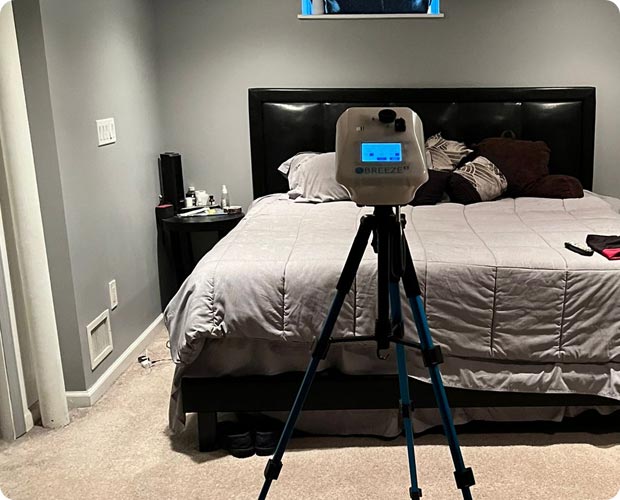
Air sampling for mold uses impaction cassettes (Air-O-Cell, Zefon BioPump) that capture particles from a calibrated air volume onto a collection medium. The cassette is analysed by a qualified analyst under microscopy. Results are reported as spores per cubic metre for each species identified. Critically, indoor samples must always be compared to an outdoor control sample taken simultaneously — outdoor spore counts vary by season, weather, and location.