
Mold testing in Yonkers: what to know
A lot of Yonkers was built into the hillside above the Hudson — pre-war apartment buildings and single-family homes from the 1900s through the 1950s, many of them brick and masonry from an era before modern waterproofing was even a standard practice. That's part of what gives Yonkers its character, but it also means basement and top-floor mold shows up more often here than in newer towns nearby — not because anyone's neglected the building, just because of when and how it was built.
Yonkers gets real winters — cold, snowy, with the kind of freeze-thaw cycles that build ice dams on older roofs. Ice dams push meltwater back up under shingles instead of off the roof, and that water finds its way into attic spaces and wall cavities where it sits, unseen, until it's mold. If you've noticed a stain on a top-floor ceiling after a thaw, that's usually where it started.
The city's water mains are ageing too, a lot of them dating to the early-to-mid 20th century, so main breaks and slow service-line leaks happen more often here than in a newer municipality — and in a multi-family building, that kind of leak can saturate basement framing quietly for a while before anyone reports it. If your building has had a water main issue nearby, it's worth having your basement checked even if nothing looks obviously wrong yet.
Mold conditions in Yonkers
Common mold types in this area: Cladosporium (the common background species, elevated indoors once there's basement moisture); Penicillium/Aspergillus (frequent in older apartment basements and original plaster walls); Stachybotrys chartarum ('black mold' — points to chronic seepage or a main-break event, not a fresh leak); Chaetomium (a sign of a long-standing moisture problem, often from a roof or ice-dam leak that's been going on a while).
We serve Hudson River Museum, Philipse Manor Hall State Historic Site, Untermyer Park and Gardens, Empire City Casino at Yonkers Raceway, Yonkers waterfront on the Hudson River and the wider Yonkers area across ZIP codes 10710, 10701, 10703, 10704, 10705.
Signs you need mold testing
- Unexplained musty odour with no visible mold
- Health symptoms that improve when occupants leave the building
- Post-remediation verification that work was completed successfully
- Pre-purchase due diligence on a home or commercial property
- Landlord-tenant dispute requiring independent third-party documentation
- Insurance claim requiring laboratory evidence of mold type and extent
How we handle mold testing in Yonkers
Mold testing is not the same as a mold inspection. Testing refers specifically to the collection and laboratory analysis of air or surface samples to identify mold species and quantify spore concentrations. An inspection includes testing but also includes a visual survey, moisture mapping, and a written remediation protocol. Testing alone — without the inspection context — can produce data that is difficult to interpret correctly.
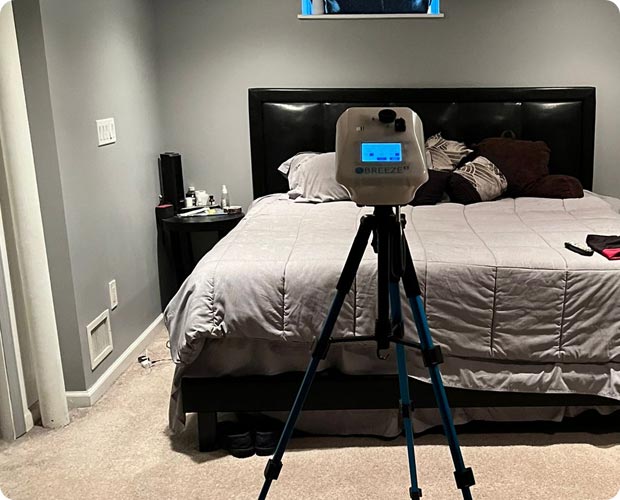
Air sampling for mold uses impaction cassettes (Air-O-Cell, Zefon BioPump) that capture particles from a calibrated air volume onto a collection medium. The cassette is analysed by a qualified analyst under microscopy. Results are reported as spores per cubic metre for each species identified. Critically, indoor samples must always be compared to an outdoor control sample taken simultaneously — outdoor spore counts vary by season, weather, and location.