
Mold testing in Sterling: what to know
If you're in Sterling, you're in Loudoun County's Dulles Toll Road corridor — one of the fastest-growing parts of Northern Virginia over the past three decades, with housing ranging from 1970s–1980s original subdivisions to newer construction built to serve the data-center and tech-corridor economy that's grown up around Dulles Airport.
A lot of Sterling's older subdivisions were built quickly during that early growth wave, and standard slab and crawl-space construction from that era sometimes has grading and drainage that hasn't kept pace with how much the surrounding area has been paved and built out since — more impervious surface nearby means more runoff pressure on the same original drainage.
Sterling sits close to the Potomac and several feeder streams, and low-lying properties near those waterways carry a real, documented stormwater risk after the kind of intense summer thunderstorms common to this part of Virginia.
Mold conditions in Sterling
Common mold types in this area: Cladosporium (crawl spaces and slab foundations in 1970s–1980s subdivisions); Stachybotrys chartarum (drainage strained by decades of subsequent paving and development); Penicillium/Aspergillus (HVAC condensate issues in newer tech-corridor construction); Chaetomium (long-standing moisture near Potomac-feeder streams).
We serve Dulles International Airport (nearby), Dulles Town Center, Potomac River, Claude Moore Park, Algonkian Regional Park and the wider Sterling area across ZIP codes 20164, 20165, 20166.
Signs you need mold testing
- Unexplained musty odour with no visible mold
- Health symptoms that improve when occupants leave the building
- Post-remediation verification that work was completed successfully
- Pre-purchase due diligence on a home or commercial property
- Landlord-tenant dispute requiring independent third-party documentation
- Insurance claim requiring laboratory evidence of mold type and extent
How we handle mold testing in Sterling
Mold testing is not the same as a mold inspection. Testing refers specifically to the collection and laboratory analysis of air or surface samples to identify mold species and quantify spore concentrations. An inspection includes testing but also includes a visual survey, moisture mapping, and a written remediation protocol. Testing alone — without the inspection context — can produce data that is difficult to interpret correctly.
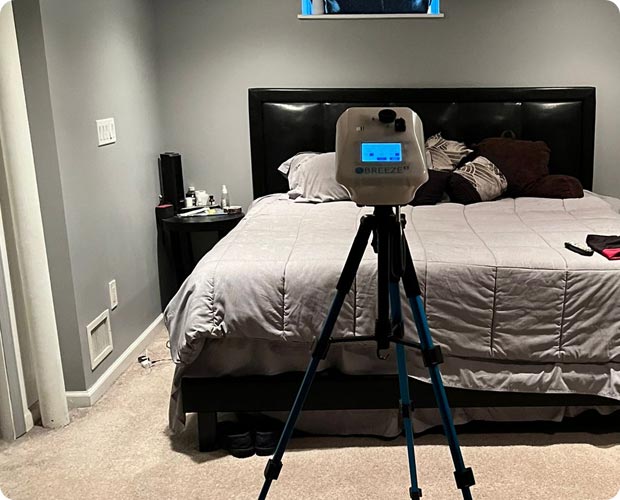
Air sampling for mold uses impaction cassettes (Air-O-Cell, Zefon BioPump) that capture particles from a calibrated air volume onto a collection medium. The cassette is analysed by a qualified analyst under microscopy. Results are reported as spores per cubic metre for each species identified. Critically, indoor samples must always be compared to an outdoor control sample taken simultaneously — outdoor spore counts vary by season, weather, and location.