
Crawl space mold in Sterling: what to know
If you're in Sterling, you're in Loudoun County's Dulles Toll Road corridor — one of the fastest-growing parts of Northern Virginia over the past three decades, with housing ranging from 1970s–1980s original subdivisions to newer construction built to serve the data-center and tech-corridor economy that's grown up around Dulles Airport.
A lot of Sterling's older subdivisions were built quickly during that early growth wave, and standard slab and crawl-space construction from that era sometimes has grading and drainage that hasn't kept pace with how much the surrounding area has been paved and built out since — more impervious surface nearby means more runoff pressure on the same original drainage.
Sterling sits close to the Potomac and several feeder streams, and low-lying properties near those waterways carry a real, documented stormwater risk after the kind of intense summer thunderstorms common to this part of Virginia.
Mold conditions in Sterling
Common mold types in this area: Cladosporium (crawl spaces and slab foundations in 1970s–1980s subdivisions); Stachybotrys chartarum (drainage strained by decades of subsequent paving and development); Penicillium/Aspergillus (HVAC condensate issues in newer tech-corridor construction); Chaetomium (long-standing moisture near Potomac-feeder streams).
We serve Dulles International Airport (nearby), Dulles Town Center, Potomac River, Claude Moore Park, Algonkian Regional Park and the wider Sterling area across ZIP codes 20164, 20165, 20166.
Signs you need crawl space mold
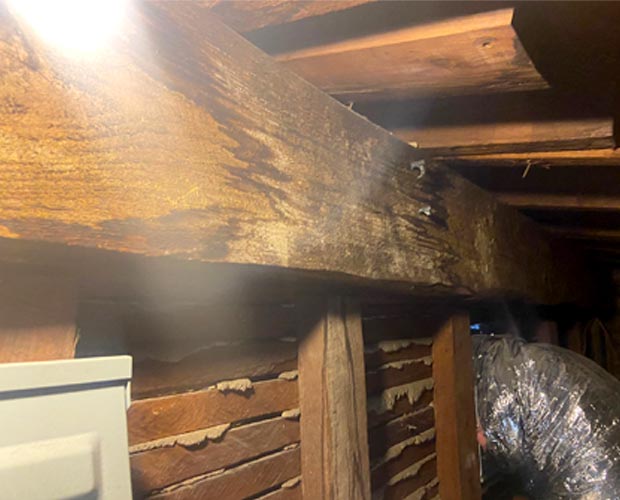
- Dark staining or fuzzy growth on floor joists or subfloor decking visible through the crawl-space access
- Musty odour rising from floor areas or floor registers
- Soft spots or springiness in floors above the crawl space
- Increased allergy or respiratory symptoms for ground-floor occupants
- Evidence of standing water, saturated soil, or moisture-damaged insulation in the crawl space
- Rust on metal fasteners, HVAC components, or pipes in the crawl space
How we handle crawl space mold in Sterling
Crawl spaces are among the most neglected areas in residential construction and among the most common locations for extensive mold growth. Ground moisture vapour rises from unprotected soil, condenses on the cooler wood framing above, and creates the persistently humid environment that Cladosporium, Penicillium, Aspergillus, and Stachybotrys require to grow. In warm climates like Miami, humid outdoor air entering through vents creates the same problem.
Crawl space mold on floor joists and subfloor decking is particularly serious because it directly contacts the structural components that support the living areas above. Mold-colonised wood also experiences fungal decay (wood rot) over time, which can compromise structural integrity. Early remediation protects both air quality and structure.