
Crawl space mold in Mount Pleasant: what to know
If you're along Mount Pleasant Street, you're likely in a late-1800s Victorian rowhouse; set back on a landscaped courtyard, you're probably in an early-1900s garden apartment building. Those garden-apartment below-grade laundry and mechanical rooms are a common, often-overlooked source of building-wide humidity that residents don't always connect to their own unit's smell.
You're close to Rock Creek Park's ravine terrain here, and if you're on one of the lower, creek-adjacent blocks, groundwater intrusion is a documented, more pronounced risk than on the flatter blocks toward Columbia Heights.
If your Victorian rowhouse has a deep, narrow lot with limited side-yard drainage — common in Mount Pleasant — grading that channels roof runoff back toward your foundation instead of away from it is a common, fixable contributor to basement moisture, and it's worth having checked even before you see a problem.
Mold conditions in Mount Pleasant
Common mold types in this area: Cladosporium (creek-adjacent groundwater intrusion on lower blocks); Penicillium/Aspergillus (garden-apartment below-grade laundry and mechanical rooms); Stachybotrys chartarum (poor-grading foundation moisture in narrow-lot Victorian rowhouses); Chaetomium (long-standing moisture in older wood-frame porches and trim).
We serve Mount Pleasant Street, Rock Creek Park, Sarah Ann Knott Memorial Fountain, Mount Pleasant Farmers Market, Carter Barron Amphitheatre (nearby) and the wider Mount Pleasant area across ZIP codes 20010.
Signs you need crawl space mold
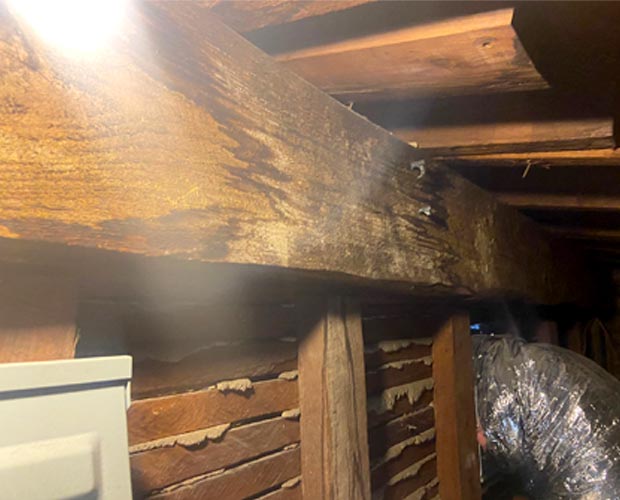
- Dark staining or fuzzy growth on floor joists or subfloor decking visible through the crawl-space access
- Musty odour rising from floor areas or floor registers
- Soft spots or springiness in floors above the crawl space
- Increased allergy or respiratory symptoms for ground-floor occupants
- Evidence of standing water, saturated soil, or moisture-damaged insulation in the crawl space
- Rust on metal fasteners, HVAC components, or pipes in the crawl space
How we handle crawl space mold in Mount Pleasant
Crawl spaces are among the most neglected areas in residential construction and among the most common locations for extensive mold growth. Ground moisture vapour rises from unprotected soil, condenses on the cooler wood framing above, and creates the persistently humid environment that Cladosporium, Penicillium, Aspergillus, and Stachybotrys require to grow. In warm climates like Miami, humid outdoor air entering through vents creates the same problem.
Crawl space mold on floor joists and subfloor decking is particularly serious because it directly contacts the structural components that support the living areas above. Mold-colonised wood also experiences fungal decay (wood rot) over time, which can compromise structural integrity. Early remediation protects both air quality and structure.