
Mold inspection in Washington: what to know
If you live in one of DC's classic rowhouses — the kind that lines Shaw, LeDroit Park, Logan Circle, Dupont, and so many other neighbourhoods here — you already know your home shares walls with the ones on either side of it. That's part of what makes DC feel like DC. It also means moisture doesn't always respect a property line: a party wall built before modern waterproofing existed can carry dampness from a neighbour's foundation issue into yours, and most of this housing stock predates any waterproofing membrane at all. So if you've never had a moisture problem yourself but suddenly have one, it's not always something you did — it's often just old masonry doing what old masonry does.
A lot of DC rowhouses also have an English basement — a partially below-grade unit that's below the main house but still gets a window and a door to the street. They're a genuinely nice piece of DC housing, whether it's your guest space, your rental income, or where you actually live. They're also, structurally, the part of the house closest to the ground and furthest from fresh air circulation, which makes them the first place moisture shows up. If you rent or live in one and you've noticed a musty smell or a soft patch on a wall, you're not imagining it, and it's worth getting looked at early rather than waiting.
DC's summers are genuinely rough on a building — hot, muggy, with relative humidity regularly sitting above 65–70% from June through September. And the city's combined sewer system, which carries stormwater and sewage in the same pipes across a lot of the older parts of DC, means a hard summer storm can push water back up into basements as contaminated (Category 3) water — a different, more serious problem than a simple leak, and one that needs professional handling, not just a mop and a fan.
It's not just houses, either. A good share of downtown DC's office and mixed-use buildings run one centralised HVAC system across several floors, so a single coil or drain-pan failure can quietly spread moisture into more than one office or unit before anyone notices the smell. If that's you, you're not being paranoid to want it checked — a shared system means a shared risk.
Mold conditions in Washington
Common mold types in this area: Cladosporium (the everyday background species — shows up on window sills, trim, and basement surfaces wherever there's been sustained moisture); Penicillium/Aspergillus (common in rowhouse basements, English basements, and HVAC-served office space with chronic dampness); Stachybotrys chartarum ('black mold' — needs sustained wet conditions, so it points to a chronic leak or an under-dried sewer backup, not a one-day event); Chaetomium (a strong sign of a long-standing moisture problem, often found alongside Stachybotrys in water-damaged drywall and plaster).
We serve The National Mall, U.S. Capitol, The White House, Smithsonian National Museum of Natural History, Dupont Circle and the wider Washington area across ZIP codes 20005, 20001, 20009, 20036, 20037.
Signs you need mold inspection
- Visible discolouration or fuzzy growth on walls, ceilings, or around window frames
- A persistent musty odor, especially in a basement, crawl space, or HVAC closet
- A known past water event — a leak, flood, or slow plumbing failure — even if it was 'dried out' at the time
- Water staining, efflorescence, or bubbling paint on interior surfaces
- Allergy-type symptoms that improve when away from the property
How we handle mold inspection in Washington
MoldAct's three markets present three different moisture problems. Baltimore's brick rowhouses — most built between 1870 and 1940 on unreinforced foundations with no waterproofing membrane — see basement seepage as a near-universal condition, and the region's humid subtropical summers keep relative humidity above 70% for months at a time. In Newark and Jersey City, the same story plays out in century-old three- and four-family houses with original plumbing and unreinforced masonry. In Miami, the driver flips from ageing infrastructure to sheer climate: 70-90% relative humidity year-round means any building envelope failure or HVAC malfunction produces mold within 48-72 hours, in Art Deco-era buildings whose hollow-core block and plaster-over-lath construction hold moisture differently than modern drywall.
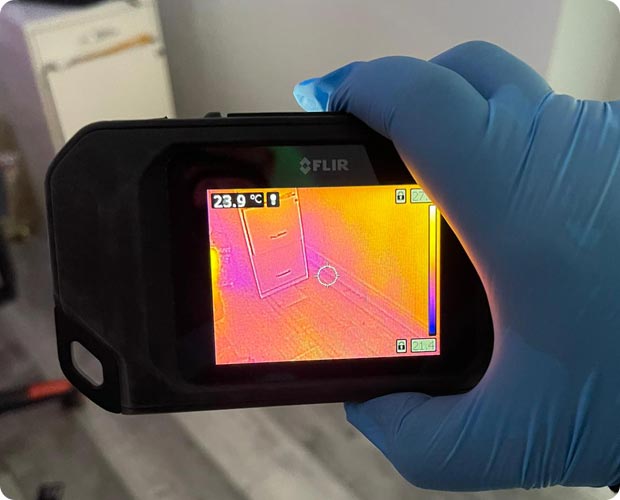
Because mold only grows where a water source, organic material, and warmth all converge, an inspection has to trace the moisture, not just photograph the visible growth. A licensed assessor uses moisture meters and thermal imaging to find wet material behind finishes, then collects air samples — always paired with a simultaneous outdoor sample, since an indoor spore count means nothing without that comparison point.