
Mold inspection in Reston: what to know
If you're in Reston, you're in one of the first master-planned communities in the country — founded in 1964 around clusters of townhomes, condos, and single-family homes set into mature woodland and man-made lakes like Lake Anne and Lake Thoreau. That heavy tree canopy is part of what makes Reston Reston, but it also means shaded, slow-to-dry ground around foundations, especially on lots backing onto common woodland.
A lot of Reston's original 1960s–1970s townhome clusters have shared party walls and common-area drainage systems designed for a much smaller stormwater load than today's more built-out Reston carries — if your townhome cluster's common drainage is undersized or aging, that's often the real source of a basement or crawl-space problem that looks like it's coming from inside your own unit.
If you're in one of Reston's many condo or garden-apartment buildings near the lakes, below-grade parking and mechanical levels close to the water table are worth having checked if you notice a smell, the same way a riverfront building would be anywhere else in the region.
Mold conditions in Reston
Common mold types in this area: Cladosporium (shaded, slow-to-dry foundations under mature tree canopy); Stachybotrys chartarum (aging common-area drainage in original 1960s–1970s townhome clusters); Penicillium/Aspergillus (below-grade parking and mechanical levels near the lakes); Chaetomium (long-standing moisture in older townhome party walls).
We serve Lake Anne Plaza, Reston Town Center, Lake Thoreau, Walker Nature Center, Wiehle-Reston East Metro and the wider Reston area across ZIP codes 20190, 20191, 20194.
Signs you need mold inspection
- Visible discolouration or fuzzy growth on walls, ceilings, or around window frames
- A persistent musty odor, especially in a basement, crawl space, or HVAC closet
- A known past water event — a leak, flood, or slow plumbing failure — even if it was 'dried out' at the time
- Water staining, efflorescence, or bubbling paint on interior surfaces
- Allergy-type symptoms that improve when away from the property
How we handle mold inspection in Reston
MoldAct's three markets present three different moisture problems. Baltimore's brick rowhouses — most built between 1870 and 1940 on unreinforced foundations with no waterproofing membrane — see basement seepage as a near-universal condition, and the region's humid subtropical summers keep relative humidity above 70% for months at a time. In Newark and Jersey City, the same story plays out in century-old three- and four-family houses with original plumbing and unreinforced masonry. In Miami, the driver flips from ageing infrastructure to sheer climate: 70-90% relative humidity year-round means any building envelope failure or HVAC malfunction produces mold within 48-72 hours, in Art Deco-era buildings whose hollow-core block and plaster-over-lath construction hold moisture differently than modern drywall.
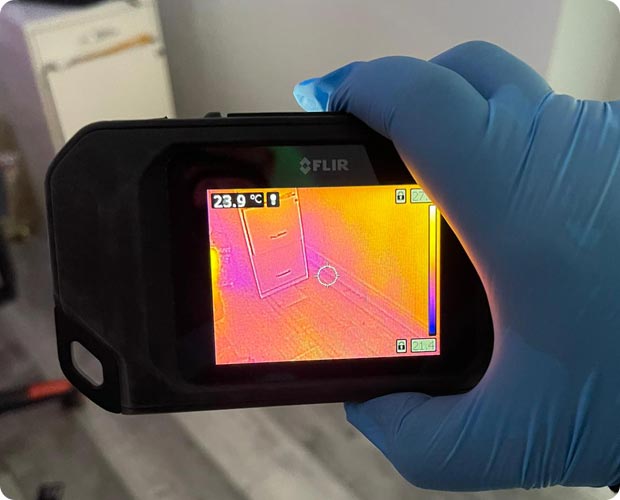
Because mold only grows where a water source, organic material, and warmth all converge, an inspection has to trace the moisture, not just photograph the visible growth. A licensed assessor uses moisture meters and thermal imaging to find wet material behind finishes, then collects air samples — always paired with a simultaneous outdoor sample, since an indoor spore count means nothing without that comparison point.