
Mold remediation in Reston: what to know
If you're in Reston, you're in one of the first master-planned communities in the country — founded in 1964 around clusters of townhomes, condos, and single-family homes set into mature woodland and man-made lakes like Lake Anne and Lake Thoreau. That heavy tree canopy is part of what makes Reston Reston, but it also means shaded, slow-to-dry ground around foundations, especially on lots backing onto common woodland.
A lot of Reston's original 1960s–1970s townhome clusters have shared party walls and common-area drainage systems designed for a much smaller stormwater load than today's more built-out Reston carries — if your townhome cluster's common drainage is undersized or aging, that's often the real source of a basement or crawl-space problem that looks like it's coming from inside your own unit.
If you're in one of Reston's many condo or garden-apartment buildings near the lakes, below-grade parking and mechanical levels close to the water table are worth having checked if you notice a smell, the same way a riverfront building would be anywhere else in the region.
Mold conditions in Reston
Common mold types in this area: Cladosporium (shaded, slow-to-dry foundations under mature tree canopy); Stachybotrys chartarum (aging common-area drainage in original 1960s–1970s townhome clusters); Penicillium/Aspergillus (below-grade parking and mechanical levels near the lakes); Chaetomium (long-standing moisture in older townhome party walls).
We serve Lake Anne Plaza, Reston Town Center, Lake Thoreau, Walker Nature Center, Wiehle-Reston East Metro and the wider Reston area across ZIP codes 20190, 20191, 20194.
Signs you need mold remediation
- Visible mold covering more than about 10 square feet — beyond a DIY-scale cleanup
- Musty odor or visible growth returning after a bleach or store-bought spray treatment
- Mold on porous material — drywall, insulation, carpet — that can't simply be wiped clean
- A documented moisture event (flood, chronic leak) with mold discovered afterward
- A written inspection protocol in hand and ready to act on
How we handle mold remediation in Reston
Across MoldAct's markets the remediation process is the same standard — S520 — but the moisture source it's chasing differs by geography. In Baltimore and the older NJ housing stock, the source is usually chronic: ageing plumbing, foundations with failed or absent waterproofing, decades of intermittent seepage. In Miami, source correction more often means a single acute event — an HVAC condensate line, a balcony seal, a hurricane-season roof or window failure — but the fast climate means the window to act before Stachybotrys establishes (roughly 8-12 days of sustained wetting) is shorter.
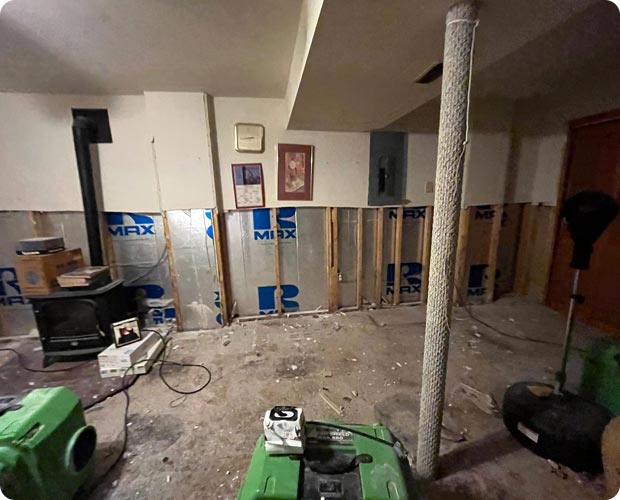
Source correction always comes first: remediating mold without fixing what's making it wet is remediation that will need to be repeated. From there, containment scales to the affected area — poly sheeting over a small localised area, or a full floor-to-ceiling barrier with negative air pressure (HEPA scrubbers) for larger or Condition 3 jobs.