
Saltar al contenido
Remediación de moho licenciada — llame para agendar
EN
MoldAct logo MoldAct Remediación de Moho Certificada IICRC S520
Crew in hazmat suits sanitizing a surface affected by black mold growth

Eliminación de Moho Negro en Foggy Bottom

La eliminación del moho negro requiere un protocolo IICRC S520 completo: evaluación independiente, contención con presión de aire negativa, eliminación física y prueba de autorización — el aerosol bleach no es remediación.

Obtenga su Inspección de Moho Gratis

O llame ahora: (877) 660-0430

Eliminación de moho negro en Foggy Bottom: lo que debe saber

Foggy Bottom debe su nombre al terreno bajo y antiguamente pantanoso a lo largo del Potomac que históricamente atrapaba niebla y humo industrial — ese mismo terreno bajo y húmedo significa que el agua subterránea y la humedad de los cimientos siempre han sido un factor más persistente aquí que en los vecindarios de mayor elevación de DC.

Si su casa adosada está junto a una de las grandes instituciones aquí — GWU, el Departamento de Estado, el Banco Mundial — sus grandes sistemas de aire acondicionado centralizados pueden desarrollar fallas de condensación que se extienden a su pared medianera adyacente.

Condiciones de moho en Foggy Bottom

Tipos de moho comunes en esta zona: Cladosporium (low-lying, historically marshy ground and its effect on foundation moisture); Penicillium/Aspergillus (institutional HVAC systems adjacent to residential party walls); Stachybotrys chartarum (student-rental units with delayed leak reporting); Chaetomium (older rowhouse basements with chronic groundwater proximity).

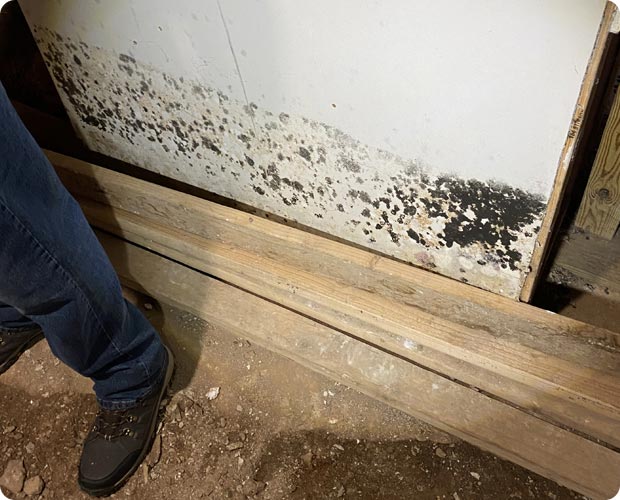
Señales de que necesita eliminación de moho negro

  • Dark green, black, or greenish-black colonies on drywall, wood, or ceiling tiles
  • Mold with a slimy or wet-looking surface texture (unlike dry, powdery Cladosporium)
  • Musty or damp earthy odour in a basement, bathroom, or behind walls
  • Mold growth in areas with a history of prolonged water exposure or chronic leaks
  • Laboratory results identifying Stachybotrys on air or surface samples
  • Health symptoms improving when leaving the property and returning when inside
Simple, transparent process

Nuestro Proceso de Eliminación de Moho Negro en Foggy Bottom

  1. 1

    Independent assessment and species confirmation

    A licensed mold assessor collects surface samples from the suspected area and submits them to an AIHA laboratory. Stachybotrys is confirmed by microscopic morphology. The assessor prepares a written protocol specifying Level III containment and removal scope.

  2. 2

    Level III containment

    The work area is sealed with 6-mil poly sheeting on all surfaces including the floor. A HEPA-filtered negative air machine operates continuously throughout the job, drawing contaminated air out through the HEPA filter. Workers wear full PPE: P100 half or full-face respirator, Tyvek suit, gloves, and boot covers.

  3. 3

    Physical removal of all contaminated porous materials

    All affected drywall, insulation, carpet, and other porous materials are removed and bagged inside the containment. No encapsulant is applied over Stachybotrys — the contaminated material must be physically removed.

  4. 4

    Structural surface treatment

    Exposed wood framing and masonry are HEPA-vacuumed, wire-brushed if needed, and treated with an EPA-registered antifungal. A barrier coating may be applied to clean, dry structural wood after treatment per the protocol.

  5. 5

    Independent clearance test

    Clearance samples are taken while containment is still in place. For Stachybotrys, surface samples from previously contaminated areas are included alongside air samples. Results must confirm the contaminated area is at normal (Condition 1) spore levels before containment is removed.

Eliminación de Moho Negro en Foggy Bottom — Preguntas Frecuentes

¿Proporcionan eliminación de moho negro en Foggy Bottom?

Sí — MoldAct proporciona eliminación de moho negro en Foggy Bottom (códigos postales: 20037). Llámenos para programar la cita disponible más cercana.

Is black mold dangerous?

All molds at elevated indoor levels can cause adverse health effects, particularly in sensitive individuals. Stachybotrys is associated with a range of symptoms including respiratory irritation, coughing, and in cases of prolonged heavy exposure, more serious health effects. If black mold is suspected, limit time in the affected area and schedule an inspection immediately.

Can I remove black mold myself?

Small areas (under 10 sq ft) of surface mold on non-porous materials may be cleaned with appropriate PPE. However, Stachybotrys on porous materials (drywall, wood) requires professional remediation. DIY attempts typically disturb the colony and aerosolise spores without adequately containing them, spreading contamination to adjacent areas.

How do I know if I have black mold?

Visual appearance is not sufficient — many molds are dark-coloured but not Stachybotrys, and not all Stachybotrys looks black. Laboratory identification from a surface sample by an AIHA-accredited lab is the only reliable confirmation.

Eliminación de Moho Negro en Foggy Bottom — reserve hoy

Contratistas de remediación de moho certificados IICRC. Llame para agendar.

Llamar Cotización