
Skip to content
Licensed mold remediation — call to schedule
ES
MoldAct logo MoldAct IICRC S520 Certified Mold Remediation
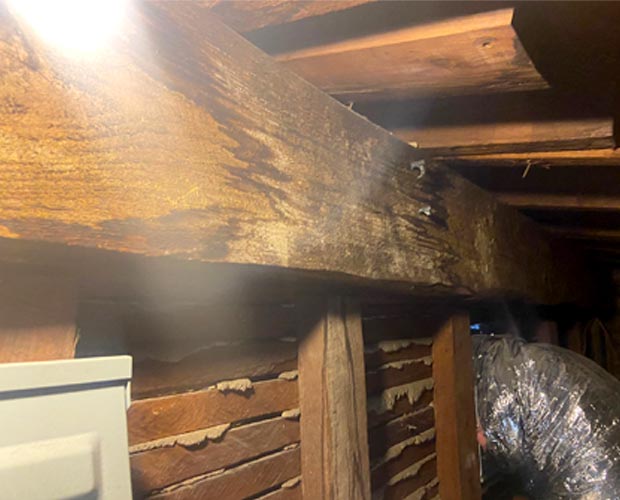
Extensive mold growth on wooden joists and insulation inside a home's crawl space

Crawl Space Mold Remediation in Logan Circle, DC

Crawl space mold is driven by ground moisture vapour and inadequate ventilation — remediation includes IICRC S520 treatment of floor joists and subfloor framing, followed by ground vapour barrier installation and ventilation correction to prevent recurrence.

Get Your Free Mold Inspection

Or call now: (877) 660-0430

Crawl space mold in Logan Circle: what to know

If your Logan Circle rowhouse is one of the grand Victorians built between 1875 and 1900 around the circle's park, it likely went through decades as a divided rooming house before the neighbourhood's more recent renovation wave. A lot of those older renovations sealed up original chimneys and vents without replacing the airflow they used to provide — which can trap moisture inside wall cavities that used to breathe, quietly, for years.

You're on DC's older combined sewer system here, same as much of the historic core — stormwater and sewage share the same pipes, so a hard summer storm can push contaminated (Category 3) water back into your basement instead of just rainwater. That's a different, more serious problem than a simple leak, and it needs to be treated that way.

If your building was converted into condos — a lot of Logan Circle's rowhouses were — a single moisture event like a roof leak or a shared stack failure can affect multiple owners before anyone traces it back to the source. If you're chasing a smell with no obvious cause in your own unit, it's worth checking whether it's really a building-wide issue.

Mold conditions in Logan Circle

Common mold types in this area: Stachybotrys chartarum ('black mold' — sealed chimneys/vents trapping moisture in older Victorian wall cavities); Chaetomium (long-standing leaks in condo-converted rowhouses); Cladosporium (everyday background growth on window sills and trim); Penicillium/Aspergillus (basement units and shared-stack plumbing failures).

We serve Logan Circle Park, 14th Street corridor, Studio Theatre, Whole Foods P Street, Vermont Avenue rowhouse row and the wider Logan Circle area across ZIP codes 20005, 20009.

Signs you need crawl space mold

  • Dark staining or fuzzy growth on floor joists or subfloor decking visible through the crawl-space access
  • Musty odour rising from floor areas or floor registers
  • Soft spots or springiness in floors above the crawl space
  • Increased allergy or respiratory symptoms for ground-floor occupants
  • Evidence of standing water, saturated soil, or moisture-damaged insulation in the crawl space
  • Rust on metal fasteners, HVAC components, or pipes in the crawl space

How we handle crawl space mold in Logan Circle

Crawl spaces are among the most neglected areas in residential construction and among the most common locations for extensive mold growth. Ground moisture vapour rises from unprotected soil, condenses on the cooler wood framing above, and creates the persistently humid environment that Cladosporium, Penicillium, Aspergillus, and Stachybotrys require to grow. In warm climates like Miami, humid outdoor air entering through vents creates the same problem.

Crawl space mold on floor joists and subfloor decking is particularly serious because it directly contacts the structural components that support the living areas above. Mold-colonised wood also experiences fungal decay (wood rot) over time, which can compromise structural integrity. Early remediation protects both air quality and structure.

Simple, transparent process

Our Logan Circle Crawl Space Mold Remediation Process

  1. 1

    Crawl space assessment

    The licensed assessor enters the crawl space to document mold growth on floor joists, subfloor, insulation, and any HVAC components. Moisture readings are taken at multiple points. Laboratory samples are collected from affected framing.

  2. 2

    Material removal

    Fiberglass batt or other insulation between floor joists is typically removed — it holds moisture and cannot be reliably remediated. Insulation is bagged and disposed of as mold-contaminated waste.

  3. 3

    Structural wood remediation

    Floor joists and subfloor decking are HEPA-vacuumed, wire-brushed to remove loose mold, and treated with an EPA-registered antifungal. For heavily colonised wood, media blasting (dry ice or soda) may be specified in the protocol for more thorough surface cleaning.

  4. 4

    Ground vapour barrier installation

    After clearance, the crawl-space floor is covered with a ground vapour barrier. A basic installation uses 6-mil poly; a full encapsulation uses 20-mil reinforced polyethylene sealed at all seams and taped to the foundation walls, effectively converting the crawl space into a conditioned space.

  5. 5

    Ventilation correction

    Vented crawl spaces in humid climates (Miami, coastal NJ) often benefit from converting to an unvented, conditioned crawl space — warm humid outdoor air entering through vents condenses on cooler surfaces inside. The appropriate ventilation strategy is specified in the clearance report.

Crawl Space Mold Remediation in Logan Circle — FAQs

Do you provide crawl space mold in Logan Circle?

Yes — MoldAct provides crawl space mold throughout Logan Circle, DC (ZIP codes: 20005, 20009) and surrounding Washington DC areas. Call us to book the earliest available appointment.

Can I remediate crawl space mold myself?

Crawl space work requires confined-space precautions, full PPE, and access to HEPA vacuums and antifungal agents. Given the structural implications of crawl-space mold and the difficulty of achieving clearance without professional equipment, professional remediation is strongly recommended.

How much does crawl space mold remediation cost?

A typical residential crawl space remediation (excluding encapsulation) costs $2,000–$6,000 depending on size and mold extent. Full encapsulation adds $3,000–$8,000. The combined cost is almost always less than the structural repair costs if framing decay is allowed to progress.

Does crawl space mold affect the indoor air quality upstairs?

Yes — the 'stack effect' draws crawl-space air upward through floor gaps, electrical penetrations, and HVAC systems into living areas. Crawl-space mold is a direct contributor to elevated indoor spore counts on the floors above.

Crawl Space Mold Remediation in Logan Circle — book today

Licensed, insured mold remediation contractors. Call to schedule.

Call Now Free Quote