
Crawl space mold in Leonia: what to know
Leonia is a small Bergen County borough on the western slope of the Palisades, bordering Englewood, Fort Lee, Palisades Park, Ridgefield Park and Teaneck. A land development begun in 1899 drew many academics and artists, earning it the nickname the Athens of New Jersey, so a good share of its homes are early-twentieth-century houses.
Homes of that age commonly have older foundations, original roofing and plumbing, and basements without modern waterproofing, so basement seepage, deferred roof maintenance and slow leaks are typical sources of hidden moisture.
Overpeck Creek, a tributary of the Hackensack River, flows past Leonia and the borough shares Overpeck County Park with neighbouring towns. Lower-lying properties near the creek corridor can be exposed to groundwater and runoff after heavy rain, and humid New Jersey summers add routine condensation risk.
Mold conditions in Leonia
Common mold types in this area: Cladosporium (basement walls and window frames in older houses); Penicillium (plaster and drywall below ageing roofs and plumbing); Chaetomium (framing and plaster after long-term leaks); Stachybotrys (basements after chronic seepage or flooding).
We serve Overpeck County Park, Leonia Public Library, Cole-Allaire House and the wider Leonia area across ZIP codes 07605.
Signs you need crawl space mold
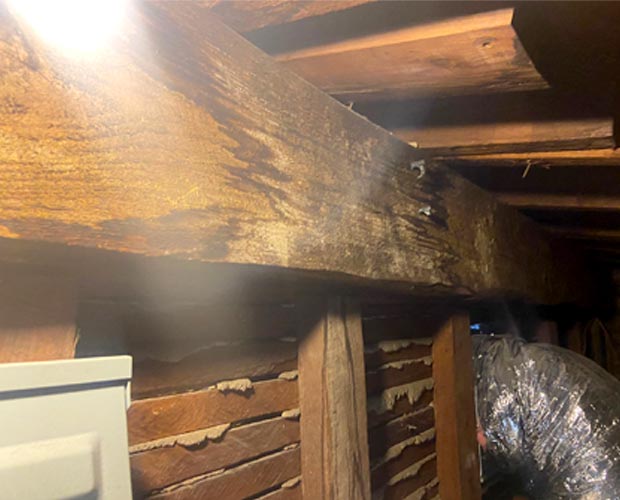
- Dark staining or fuzzy growth on floor joists or subfloor decking visible through the crawl-space access
- Musty odour rising from floor areas or floor registers
- Soft spots or springiness in floors above the crawl space
- Increased allergy or respiratory symptoms for ground-floor occupants
- Evidence of standing water, saturated soil, or moisture-damaged insulation in the crawl space
- Rust on metal fasteners, HVAC components, or pipes in the crawl space
How we handle crawl space mold in Leonia
Crawl spaces are among the most neglected areas in residential construction and among the most common locations for extensive mold growth. Ground moisture vapour rises from unprotected soil, condenses on the cooler wood framing above, and creates the persistently humid environment that Cladosporium, Penicillium, Aspergillus, and Stachybotrys require to grow. In warm climates like Miami, humid outdoor air entering through vents creates the same problem.
Crawl space mold on floor joists and subfloor decking is particularly serious because it directly contacts the structural components that support the living areas above. Mold-colonised wood also experiences fungal decay (wood rot) over time, which can compromise structural integrity. Early remediation protects both air quality and structure.