
Skip to content
Licensed mold remediation — call to schedule
ES
MoldAct logo MoldAct IICRC S520 Certified Mold Remediation
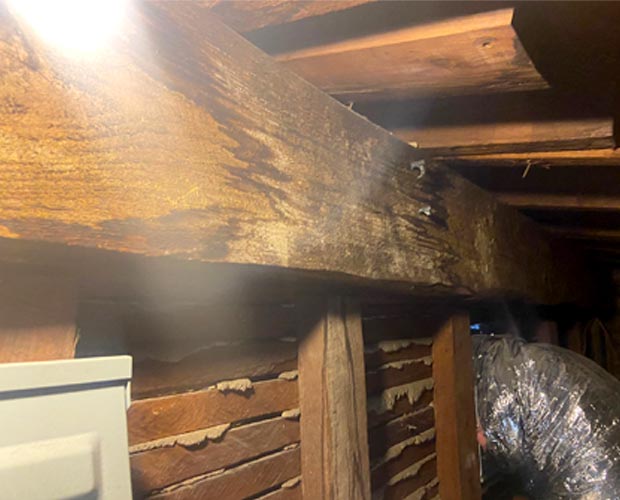
Extensive mold growth on wooden joists and insulation inside a home's crawl space

Crawl Space Mold Remediation in Hackensack, NJ

Crawl space mold is driven by ground moisture vapour and inadequate ventilation — remediation includes IICRC S520 treatment of floor joists and subfloor framing, followed by ground vapour barrier installation and ventilation correction to prevent recurrence.

Get Your Free Mold Inspection

Or call now: (877) 660-0430

Crawl space mold in Hackensack: what to know

Hackensack's position on the Hackensack River floodplain puts many lower-elevation properties at risk of basement flooding during significant storm events — particularly in the South Ward and areas near the river.

The city's significant stock of 1940s–1960s garden apartments and mid-rise residential buildings has HVAC systems that are at end of service life, with condensate issues driving mold in mechanical rooms and adjacent units.

Mold conditions in Hackensack

Common mold types in this area: Cladosporium (garden apartment basement units); Aspergillus (aging HVAC systems); Penicillium (floodplain basement storage).

We serve Main Street Hackensack, Bergen County Courthouse, Anderson Street Station, Hackensack River and the wider Hackensack area across ZIP codes 07601, 07602.

Signs you need crawl space mold

  • Dark staining or fuzzy growth on floor joists or subfloor decking visible through the crawl-space access
  • Musty odour rising from floor areas or floor registers
  • Soft spots or springiness in floors above the crawl space
  • Increased allergy or respiratory symptoms for ground-floor occupants
  • Evidence of standing water, saturated soil, or moisture-damaged insulation in the crawl space
  • Rust on metal fasteners, HVAC components, or pipes in the crawl space

How we handle crawl space mold in Hackensack

Crawl spaces are among the most neglected areas in residential construction and among the most common locations for extensive mold growth. Ground moisture vapour rises from unprotected soil, condenses on the cooler wood framing above, and creates the persistently humid environment that Cladosporium, Penicillium, Aspergillus, and Stachybotrys require to grow. In warm climates like Miami, humid outdoor air entering through vents creates the same problem.

Crawl space mold on floor joists and subfloor decking is particularly serious because it directly contacts the structural components that support the living areas above. Mold-colonised wood also experiences fungal decay (wood rot) over time, which can compromise structural integrity. Early remediation protects both air quality and structure.

Simple, transparent process

Our Hackensack Crawl Space Mold Remediation Process

  1. 1

    Crawl space assessment

    The licensed assessor enters the crawl space to document mold growth on floor joists, subfloor, insulation, and any HVAC components. Moisture readings are taken at multiple points. Laboratory samples are collected from affected framing.

  2. 2

    Material removal

    Fiberglass batt or other insulation between floor joists is typically removed — it holds moisture and cannot be reliably remediated. Insulation is bagged and disposed of as mold-contaminated waste.

  3. 3

    Structural wood remediation

    Floor joists and subfloor decking are HEPA-vacuumed, wire-brushed to remove loose mold, and treated with an EPA-registered antifungal. For heavily colonised wood, media blasting (dry ice or soda) may be specified in the protocol for more thorough surface cleaning.

  4. 4

    Ground vapour barrier installation

    After clearance, the crawl-space floor is covered with a ground vapour barrier. A basic installation uses 6-mil poly; a full encapsulation uses 20-mil reinforced polyethylene sealed at all seams and taped to the foundation walls, effectively converting the crawl space into a conditioned space.

  5. 5

    Ventilation correction

    Vented crawl spaces in humid climates (Miami, coastal NJ) often benefit from converting to an unvented, conditioned crawl space — warm humid outdoor air entering through vents condenses on cooler surfaces inside. The appropriate ventilation strategy is specified in the clearance report.

Crawl Space Mold Remediation in Hackensack — FAQs

Do you provide crawl space mold in Hackensack?

Yes — MoldAct provides crawl space mold throughout Hackensack, NJ (ZIP codes: 07601, 07602) and surrounding New Jersey areas. Call us to book the earliest available appointment.

Can I remediate crawl space mold myself?

Crawl space work requires confined-space precautions, full PPE, and access to HEPA vacuums and antifungal agents. Given the structural implications of crawl-space mold and the difficulty of achieving clearance without professional equipment, professional remediation is strongly recommended.

How much does crawl space mold remediation cost?

A typical residential crawl space remediation (excluding encapsulation) costs $2,000–$6,000 depending on size and mold extent. Full encapsulation adds $3,000–$8,000. The combined cost is almost always less than the structural repair costs if framing decay is allowed to progress.

Does crawl space mold affect the indoor air quality upstairs?

Yes — the 'stack effect' draws crawl-space air upward through floor gaps, electrical penetrations, and HVAC systems into living areas. Crawl-space mold is a direct contributor to elevated indoor spore counts on the floors above.

Crawl Space Mold Remediation in Hackensack — book today

Licensed, insured mold remediation contractors. Call to schedule.

Call Now Free Quote