
Crawl space mold in Arlington: what to know
If you're in Arlington, know first that you're in Virginia, not DC — a different state and a different legal jurisdiction, with mold disclosure and remediation rules that aren't the same as the District's. Anything written specifically for DC doesn't automatically apply to you just because you're a bridge away.
If you're in the Rosslyn-Ballston corridor, you're likely in dense, newer high-rise construction where HVAC condensate and building-envelope water intrusion are the dominant risks. If you're in one of Arlington's older single-family neighbourhoods from the 1940s–1960s post-war boom instead, your crawl space or basement behaves much more like Maryland or DC's older housing stock.
You're along the Potomac and several of its tributary streams here, Four Mile Run among them — if you're on a low-lying block near one of those waterways, stormwater and groundwater intrusion after a heavy regional storm is a documented risk for you, not a hypothetical one.
Mold conditions in Arlington
Common mold types in this area: Penicillium/Aspergillus (HVAC condensate issues in Rosslyn-Ballston high-rise construction); Cladosporium (crawl spaces in 1940s–1960s post-war single-family housing); Stachybotrys chartarum (chronic basement moisture near Four Mile Run and other low-lying areas); Chaetomium (older homes with long-standing, undetected leaks).
We serve Rosslyn-Ballston corridor, Arlington National Cemetery, The Pentagon, Clarendon, Four Mile Run and the wider Arlington area across ZIP codes 22201, 22203, 22204, 22206, 22209.
Signs you need crawl space mold
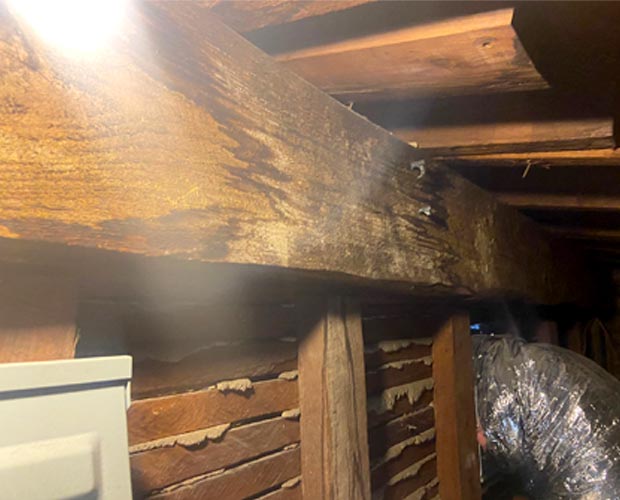
- Dark staining or fuzzy growth on floor joists or subfloor decking visible through the crawl-space access
- Musty odour rising from floor areas or floor registers
- Soft spots or springiness in floors above the crawl space
- Increased allergy or respiratory symptoms for ground-floor occupants
- Evidence of standing water, saturated soil, or moisture-damaged insulation in the crawl space
- Rust on metal fasteners, HVAC components, or pipes in the crawl space
How we handle crawl space mold in Arlington
Crawl spaces are among the most neglected areas in residential construction and among the most common locations for extensive mold growth. Ground moisture vapour rises from unprotected soil, condenses on the cooler wood framing above, and creates the persistently humid environment that Cladosporium, Penicillium, Aspergillus, and Stachybotrys require to grow. In warm climates like Miami, humid outdoor air entering through vents creates the same problem.
Crawl space mold on floor joists and subfloor decking is particularly serious because it directly contacts the structural components that support the living areas above. Mold-colonised wood also experiences fungal decay (wood rot) over time, which can compromise structural integrity. Early remediation protects both air quality and structure.