
Crawl space mold in Alexandria: what to know
If you're in Alexandria, you're in a Virginia city, legally distinct from DC. If you're in Old Town specifically, your building stock may date back to the 1750s–1800s — colonial and Federal-era brick rowhouses along the Potomac waterfront, built long before any modern foundation waterproofing existed.
Old Town sits directly on the Potomac, and if you're on one of the lowest waterfront blocks, tidal and storm-surge flooding is a well-documented risk — a below-grade room near King Street or the waterfront is dealing with both historic construction and today's climate-driven flood frequency at once.
If you're further from Old Town, in one of Alexandria's newer neighbourhoods built mostly from the 1950s onward, you're in more typical mid-Atlantic suburban construction — crawl spaces and slab foundations where HVAC condensate and grading issues, not historic masonry, are your more likely mold drivers.
Mold conditions in Alexandria
Common mold types in this area: Stachybotrys chartarum (18th-century Old Town brick foundations with chronic waterfront moisture); Chaetomium (long-standing moisture in colonial and Federal-era wood framing); Cladosporium (crawl spaces in mid-20th-century suburban construction); Penicillium/Aspergillus (HVAC condensate and grading issues in newer Alexandria neighbourhoods).
We serve Old Town Alexandria waterfront, King Street, George Washington Masonic National Memorial, Torpedo Factory Art Center, Mount Vernon (nearby) and the wider Alexandria area across ZIP codes 22301, 22302, 22304, 22314.
Signs you need crawl space mold
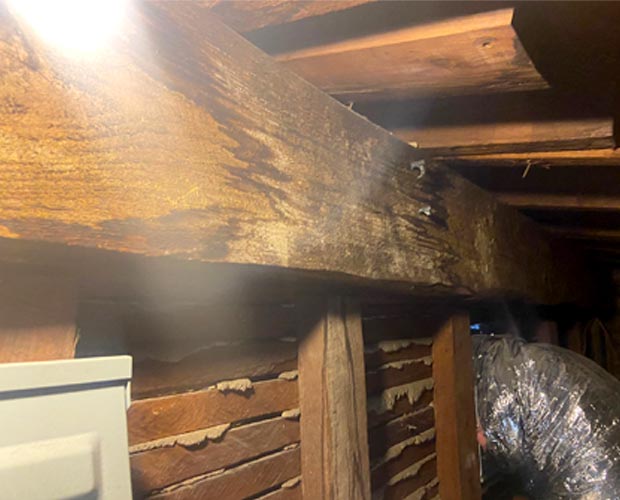
- Dark staining or fuzzy growth on floor joists or subfloor decking visible through the crawl-space access
- Musty odour rising from floor areas or floor registers
- Soft spots or springiness in floors above the crawl space
- Increased allergy or respiratory symptoms for ground-floor occupants
- Evidence of standing water, saturated soil, or moisture-damaged insulation in the crawl space
- Rust on metal fasteners, HVAC components, or pipes in the crawl space
How we handle crawl space mold in Alexandria
Crawl spaces are among the most neglected areas in residential construction and among the most common locations for extensive mold growth. Ground moisture vapour rises from unprotected soil, condenses on the cooler wood framing above, and creates the persistently humid environment that Cladosporium, Penicillium, Aspergillus, and Stachybotrys require to grow. In warm climates like Miami, humid outdoor air entering through vents creates the same problem.
Crawl space mold on floor joists and subfloor decking is particularly serious because it directly contacts the structural components that support the living areas above. Mold-colonised wood also experiences fungal decay (wood rot) over time, which can compromise structural integrity. Early remediation protects both air quality and structure.