
Crawl space mold in Severna Park: what to know
If you're on the water in Severna Park — and a lot of the community sits along the Severn River and the Chesapeake Bay's many inlets — waterfront and near-waterfront homes here carry a genuinely higher groundwater and tidal-influence risk than the inland parts of Anne Arundel County.
A lot of Severna Park's housing runs from older waterfront cottages, some dating back to the early 20th century as summer retreats before year-round living took over, through to newer suburban construction further from the shoreline — the older cottages in particular often have minimal or no foundation waterproofing at all.
The Chesapeake Bay's humid climate keeps summer humidity high here much like the rest of the mid-Atlantic, and salt-air exposure near the water accelerates the kind of building envelope wear — window seals, exterior trim — that lets moisture in over time.
Mold conditions in Severna Park
Common mold types in this area: Cladosporium (salt-air-accelerated building envelope wear near the water); Stachybotrys chartarum (older waterfront cottages with minimal or no foundation waterproofing); Penicillium/Aspergillus (newer suburban HVAC and interior humidity); Chaetomium (chronic moisture in early-20th-century summer-cottage-turned-year-round homes).
We serve Severn River, Kinder Farm Park, Jones Station Park, Downs Park (nearby), B&A Trail and the wider Severna Park area across ZIP codes 21146.
Signs you need crawl space mold
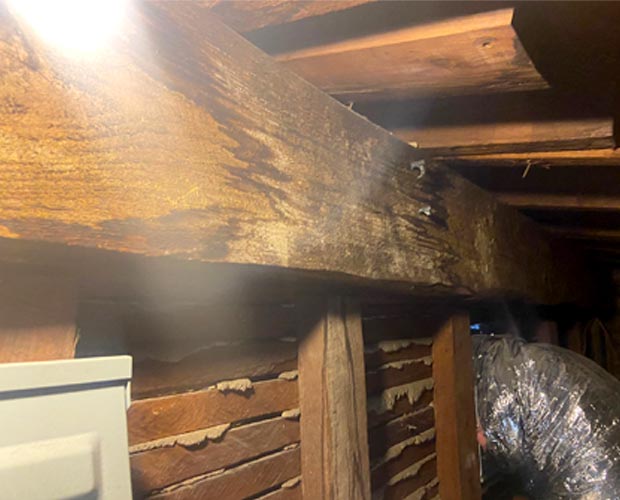
- Dark staining or fuzzy growth on floor joists or subfloor decking visible through the crawl-space access
- Musty odour rising from floor areas or floor registers
- Soft spots or springiness in floors above the crawl space
- Increased allergy or respiratory symptoms for ground-floor occupants
- Evidence of standing water, saturated soil, or moisture-damaged insulation in the crawl space
- Rust on metal fasteners, HVAC components, or pipes in the crawl space
How we handle crawl space mold in Severna Park
Crawl spaces are among the most neglected areas in residential construction and among the most common locations for extensive mold growth. Ground moisture vapour rises from unprotected soil, condenses on the cooler wood framing above, and creates the persistently humid environment that Cladosporium, Penicillium, Aspergillus, and Stachybotrys require to grow. In warm climates like Miami, humid outdoor air entering through vents creates the same problem.
Crawl space mold on floor joists and subfloor decking is particularly serious because it directly contacts the structural components that support the living areas above. Mold-colonised wood also experiences fungal decay (wood rot) over time, which can compromise structural integrity. Early remediation protects both air quality and structure.