
Bathroom mold removal in Petworth: what to know
If you're in Petworth, you're likely in a rowhouse or detached bungalow from the 1900s through the 1920s — with more yard space and original wood porches than the denser blocks closer to downtown. Those original porches and their roof flashing are a common entry point for moisture once they've aged.
If your basement is unfinished or only partly finished, it's probably still running on original 1900s-era drainage that was never designed for the stormwater a fully built-out modern block now sheds — undersized or clogged storm drains are a recurring cause of seepage here.
If you bought a recently renovated or flipped home in Petworth, it's worth knowing that a rushed basement finish over a still-damp foundation is one of the most common ways mold gets sealed inside new drywall before a buyer ever sees it — an independent inspection is the way to check what's behind the new paint.
Mold conditions in Petworth
Common mold types in this area: Stachybotrys chartarum (basement moisture sealed behind rushed renovation drywall); Cladosporium (original wood porches and trim with failed flashing); Penicillium/Aspergillus (unfinished basements with undersized-drain seepage); Chaetomium (older wood framing with chronic low-level moisture).
We serve Petworth Metro, Grant Circle, Rock Creek Church Cemetery, Georgia Avenue corridor, Petworth Recreation Center and the wider Petworth area across ZIP codes 20011.
Signs you need bathroom mold removal
- Black or greenish mould visible on grout lines, caulk, or tile surfaces
- Soft or spongy drywall at the base of the shower or bath surround
- Bubbling, cracked, or loose tiles — often indicating moisture migration behind
- Persistent musty odour in the bathroom after surface cleaning
- Staining on the ceiling below a bathroom (mold in subfloor or hidden leak)
- Visible mold at the base of toilet, vanity, or around plumbing penetrations
How we handle bathroom mold removal in Petworth
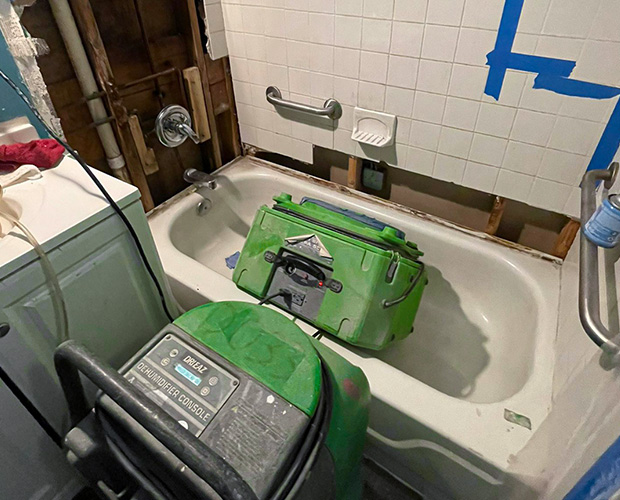
Bathroom mold is extremely common and ranges from minor surface growth on grout and caulk to serious structural mold growth behind tile, in wall cavities, and under subfloor decking. The difference matters enormously: surface mold on a non-porous substrate (glazed tile, sealed grout) can often be professionally cleaned without demolition; mold inside the wall cavity requires opening the wall, removing affected drywall and insulation, and following IICRC S520 protocol.
The most common bathroom moisture sources are: inadequate or non-functioning exhaust ventilation, grout and caulk failures that allow water into wall cavities, overflow from showers or tubs, and chronic toilet base leaks. In all cases, the moisture source must be corrected before any mold treatment — retiling over wet, contaminated drywall simply delays the problem.