
Bathroom mold removal in Arlington: what to know
If you're in Arlington, know first that you're in Virginia, not DC — a different state and a different legal jurisdiction, with mold disclosure and remediation rules that aren't the same as the District's. Anything written specifically for DC doesn't automatically apply to you just because you're a bridge away.
If you're in the Rosslyn-Ballston corridor, you're likely in dense, newer high-rise construction where HVAC condensate and building-envelope water intrusion are the dominant risks. If you're in one of Arlington's older single-family neighbourhoods from the 1940s–1960s post-war boom instead, your crawl space or basement behaves much more like Maryland or DC's older housing stock.
You're along the Potomac and several of its tributary streams here, Four Mile Run among them — if you're on a low-lying block near one of those waterways, stormwater and groundwater intrusion after a heavy regional storm is a documented risk for you, not a hypothetical one.
Mold conditions in Arlington
Common mold types in this area: Penicillium/Aspergillus (HVAC condensate issues in Rosslyn-Ballston high-rise construction); Cladosporium (crawl spaces in 1940s–1960s post-war single-family housing); Stachybotrys chartarum (chronic basement moisture near Four Mile Run and other low-lying areas); Chaetomium (older homes with long-standing, undetected leaks).
We serve Rosslyn-Ballston corridor, Arlington National Cemetery, The Pentagon, Clarendon, Four Mile Run and the wider Arlington area across ZIP codes 22201, 22203, 22204, 22206, 22209.
Signs you need bathroom mold removal
- Black or greenish mould visible on grout lines, caulk, or tile surfaces
- Soft or spongy drywall at the base of the shower or bath surround
- Bubbling, cracked, or loose tiles — often indicating moisture migration behind
- Persistent musty odour in the bathroom after surface cleaning
- Staining on the ceiling below a bathroom (mold in subfloor or hidden leak)
- Visible mold at the base of toilet, vanity, or around plumbing penetrations
How we handle bathroom mold removal in Arlington
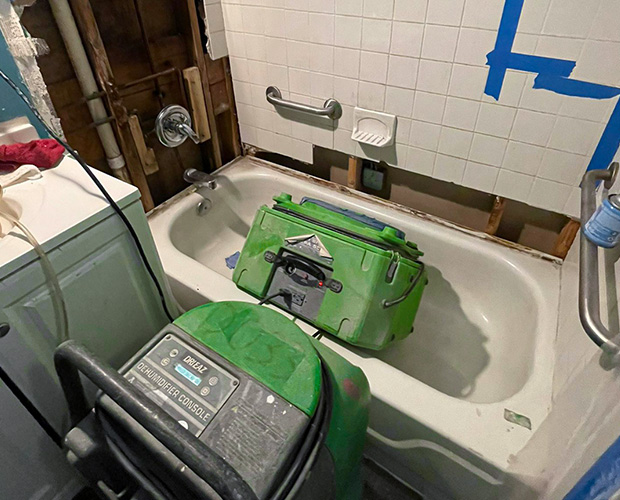
Bathroom mold is extremely common and ranges from minor surface growth on grout and caulk to serious structural mold growth behind tile, in wall cavities, and under subfloor decking. The difference matters enormously: surface mold on a non-porous substrate (glazed tile, sealed grout) can often be professionally cleaned without demolition; mold inside the wall cavity requires opening the wall, removing affected drywall and insulation, and following IICRC S520 protocol.
The most common bathroom moisture sources are: inadequate or non-functioning exhaust ventilation, grout and caulk failures that allow water into wall cavities, overflow from showers or tubs, and chronic toilet base leaks. In all cases, the moisture source must be corrected before any mold treatment — retiling over wet, contaminated drywall simply delays the problem.