
Bathroom mold removal in Aberdeen: what to know
If you're in Aberdeen, your town's identity is closely tied to Aberdeen Proving Ground, the U.S. Army installation next door, and a lot of the surrounding housing was built to serve that base and the rail and industrial activity that grew up around it — older rowhomes and modest single-family housing from the early-to-mid 20th century predominate closer to the historic core.
Aberdeen sits near the head of the Chesapeake Bay, and low-lying areas near the water and the rail corridor have a documented history of drainage challenges that older, working-class-era housing wasn't originally built to handle.
A lot of Aberdeen's older housing stock has aging plumbing and foundation drainage that's never been substantially upgraded, which makes routine inspection — not just complaint-driven response — genuinely worthwhile here even without an obvious trigger event.
Mold conditions in Aberdeen
Common mold types in this area: Chaetomium (early-to-mid-20th-century rowhomes with original, unimproved drainage); Stachybotrys chartarum (low-lying, Chesapeake-adjacent drainage challenges); Cladosporium (general background growth in older working-class housing stock); Penicillium/Aspergillus (aging plumbing systems never substantially upgraded).
We serve Aberdeen Proving Ground, Ripken Stadium, Aberdeen Ironbirds, Swan Creek, Historic Downtown Aberdeen and the wider Aberdeen area across ZIP codes 21001.
Signs you need bathroom mold removal
- Black or greenish mould visible on grout lines, caulk, or tile surfaces
- Soft or spongy drywall at the base of the shower or bath surround
- Bubbling, cracked, or loose tiles — often indicating moisture migration behind
- Persistent musty odour in the bathroom after surface cleaning
- Staining on the ceiling below a bathroom (mold in subfloor or hidden leak)
- Visible mold at the base of toilet, vanity, or around plumbing penetrations
How we handle bathroom mold removal in Aberdeen
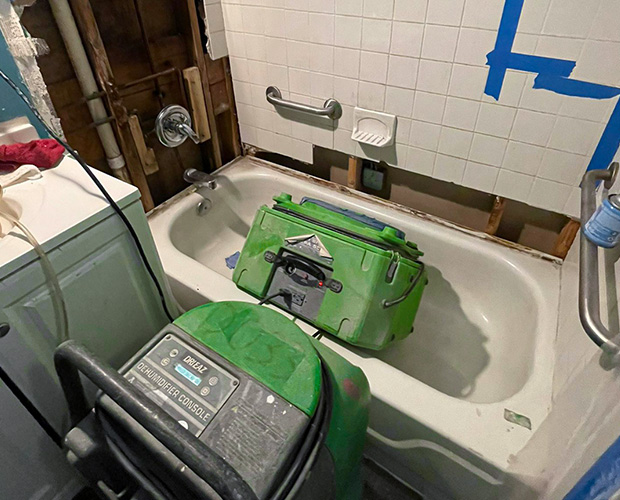
Bathroom mold is extremely common and ranges from minor surface growth on grout and caulk to serious structural mold growth behind tile, in wall cavities, and under subfloor decking. The difference matters enormously: surface mold on a non-porous substrate (glazed tile, sealed grout) can often be professionally cleaned without demolition; mold inside the wall cavity requires opening the wall, removing affected drywall and insulation, and following IICRC S520 protocol.
The most common bathroom moisture sources are: inadequate or non-functioning exhaust ventilation, grout and caulk failures that allow water into wall cavities, overflow from showers or tubs, and chronic toilet base leaks. In all cases, the moisture source must be corrected before any mold treatment — retiling over wet, contaminated drywall simply delays the problem.