
Skip to content
Licensed mold remediation — call to schedule
ES
MoldAct logo MoldAct IICRC S520 Certified Mold Remediation
Technician performing mold remediation work in a residential basement

Basement Mold Removal in Owings Mills, MD

Basement mold in MoldAct's markets almost always traces to a foundation moisture problem — an unwaterproofed rowhouse foundation in Baltimore, ageing masonry in Newark or Jersey City, or a failed sump pump in a finished Montgomery County basement — and remediation has to fix that source, not just treat the drywall or carpet sitting on top of it.

Get Your Free Mold Inspection

Or call now: (877) 660-0430

Basement mold removal in Owings Mills: what to know

If you're in Owings Mills, you're most likely in a home built during the area's major suburban growth wave from the 1980s onward — newer construction than much of Baltimore County, generally with better foundation waterproofing than the pre-war rowhouse stock closer to the city, but still vulnerable to the same HVAC and grading issues every mid-Atlantic suburb deals with.

The area's rolling Piedmont terrain and clusters of newer planned developments mean stormwater management ponds and grading are engineered features here, not an afterthought — when they're working as designed, basement moisture is genuinely less common than in older Baltimore County towns; when a pond or swale gets clogged or poorly maintained, it can concentrate runoff toward specific properties instead of dispersing it.

Owings Mills has seen continued commercial and residential development pressure over the past two decades, and newer construction basements dug near older, established properties can occasionally disrupt drainage patterns that had kept a neighbouring foundation dry for years.

Mold conditions in Owings Mills

Common mold types in this area: Cladosporium (general background growth in newer suburban construction); Penicillium/Aspergillus (HVAC condensate issues common to newer mid-Atlantic suburbs); Stachybotrys chartarum (concentrated runoff from clogged or poorly maintained stormwater management features); Chaetomium (drainage disruption from adjacent new-construction activity).

We serve Foundry Row, Owings Mills Metro Centre, Northwest Regional Park, Mount Wilson (nearby), Baltimore County community college area and the wider Owings Mills area across ZIP codes 21117.

Signs you need basement mold removal

  • Musty odor concentrated in the basement, even without visible growth
  • Visible growth on drywall, carpet, or the underside of a dropped ceiling
  • Efflorescence (white mineral deposits) or peeling paint on foundation walls — a sign of chronic moisture migration through masonry
  • A sump pump nearing end of service life, or a known history of sump pump failure
  • Standing water or dampness after heavy rain, even if it drains within a day

How we handle basement mold removal in Owings Mills

Basements fail for different structural reasons across MoldAct's service area, but the underlying physics is the same: a below-grade space with no vapor barrier, sitting against soil that's wet more often than it's dry. In Baltimore, that's rowhouses built between 1870 and 1940 on unreinforced brick foundations with no waterproofing membrane — basement seepage is close to universal in that stock. In Columbia and other Montgomery County suburbs, it's finished basements — with drywall, carpet, and dropped ceilings hiding a mold problem — where an ageing sump pump or failed exterior waterproofing (both approaching end of service life on 1970s-1990s construction) turns a wet basement into a hidden mold cavity fast.

Hampden's hillside homes add another variant: half-basements and English basements sitting below the natural grade of the hill are a landing point for groundwater working downhill during heavy rain, independent of any single storm event — a chronic condition rather than a one-off leak.

Simple, transparent process

Our Owings Mills Basement Mold Removal Process

  1. 1

    Foundation and sump inspection

    We check the actual moisture source — foundation wall condition, sump pump function, exterior grading — not just the visible drywall or carpet.

  2. 2

    Removal of finished materials

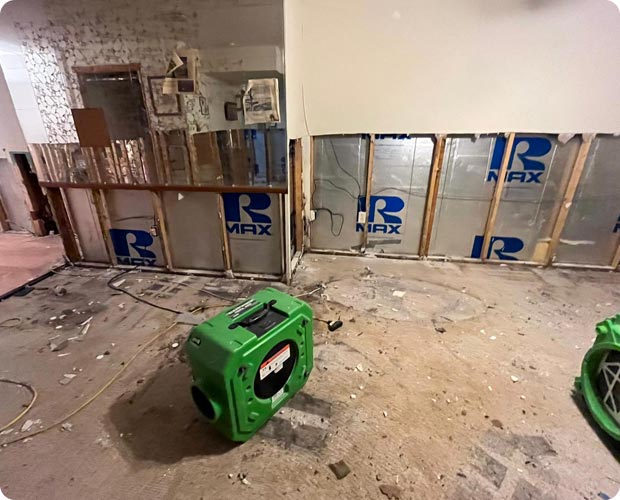
    Contaminated drywall, carpet, and dropped-ceiling material are removed rather than treated in place, since finished basements hide growth behind exactly these materials.

  3. 3

    Containment and HEPA vacuuming

    Standard S520 containment scaled to the basement's size, with HEPA vacuuming before any demolition.

  4. 4

    Structural drying and treatment

    Exposed framing and masonry are mechanically cleaned, antifungal-treated, and dried to standard before any rebuild begins.

  5. 5

    Independent clearance

    A separate assessor confirms the basement clears before finished materials go back in.

Basement Mold Removal in Owings Mills — FAQs

Do you provide basement mold removal in Owings Mills?

Yes — MoldAct provides basement mold removal throughout Owings Mills, MD (ZIP codes: 21117) and surrounding Maryland areas. Call us to book the earliest available appointment.

My basement is finished — do you need to remove the drywall?

Usually, yes, if there's confirmed growth or chronic moisture behind it. Finished materials like drywall, carpet, and dropped ceilings hide mold rather than prevent it — treating what's visible without removing contaminated finished material doesn't resolve the problem.

Is basement mold covered by insurance?

It depends on whether it followed a sudden, accidental event (like a sump pump failure or burst pipe) or a gradual condition insurers may treat as a maintenance issue. Document when the water intrusion started and keep any assessment reports.

Will fixing the sump pump stop the mold from coming back?

It's a necessary step, not the whole fix — source correction (sump pump, grading, waterproofing) has to happen before or alongside remediation, or the same conditions just regrow the mold.

How is a hillside basement in Hampden different from a rowhouse basement in Fells Point?

Hampden's half-basements sit below the natural grade of the hill, so they see groundwater pressure working downhill even without a single storm event. Fells Point's rowhouse basements are shallower but sit against unwaterproofed historic foundations, so seepage tends to follow specific heavy-rain events more directly.

Basement Mold Removal in Owings Mills — book today

Licensed, insured mold remediation contractors. Call to schedule.

Call Now Free Quote