Mold remediation built for Brookland
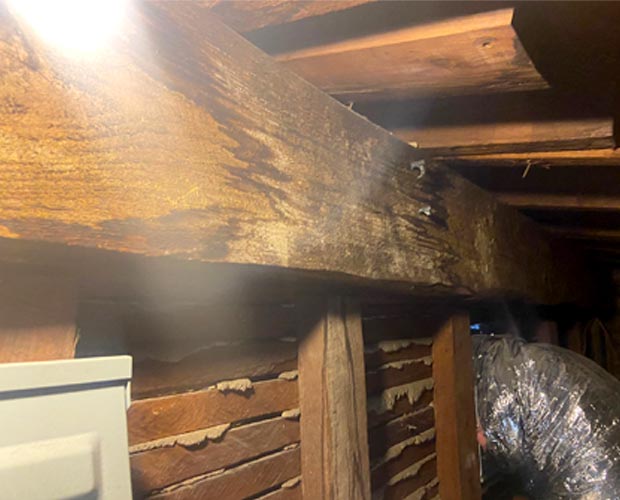
If you're in Brookland — long nicknamed 'Little Rome' for its cluster of Catholic institutions around Catholic University — your home is probably one of the 1920s–1940s bungalows or duplexes built with a crawl space rather than the raised English basement common closer to downtown. A crawl space with no vapour barrier is a slow, quiet source of mold that can sit unnoticed under a house for years — it's genuinely easy to miss.
Parts of Brookland, especially near the Rhode Island Avenue rail corridor, have older stormwater infrastructure with a documented history of localised street flooding after heavy rain, which can back up into low crawl spaces and basements. If your street floods after a storm, it's worth having your crawl space checked, not just the street.
If you're connected to one of Brookland's institutional buildings — a dormitory, rectory, or older academic hall — those often run large, centralised HVAC and boiler systems, and a single equipment failure there can raise moisture levels across several connected rooms at once, not just yours.
Common mold types in Brookland
- Cladosporium (unvented crawl spaces, the neighbourhood's dominant foundation type)
- Penicillium/Aspergillus (older institutional HVAC and boiler systems)
- Stachybotrys chartarum (chronic crawl-space moisture with no vapour barrier)
- Chaetomium (long-standing moisture in 1920s–1940s wood-frame construction)
We serve Catholic University of America, Basilica of the National Shrine, Brookland Metro, Turkey Thicket Recreation Center, Monroe Street Market and the wider Brookland area across ZIP codes 20017, 20064.