
Clearance testing in Woodbridge: what to know
If you're near the Potomac or Occoquan River in Woodbridge, low-lying, waterfront-adjacent property here has a documented history of stormwater and tidal-influenced flooding risk that inland Prince William County doesn't share — a below-grade room close to the water is worth extra scrutiny after any major storm.
A lot of Woodbridge's housing was built during the rapid suburban growth of the 1970s through 1990s, mostly slab and crawl-space construction, and the pace of that growth occasionally outran the stormwater infrastructure meant to serve it — undersized drainage in older subdivisions is a recurring, documented contributor to basement seepage.
Woodbridge's dense retail and commercial corridor around Potomac Mills runs large HVAC systems across big-box and mixed-use buildings, where condensate and drain-pan failures are the relevant commercial mold driver, distinct from what the surrounding residential subdivisions deal with.
Mold conditions in Woodbridge
Common mold types in this area: Cladosporium (crawl spaces and slab foundations across 1970s–1990s subdivisions); Stachybotrys chartarum (waterfront-adjacent flooding near the Potomac and Occoquan); Penicillium/Aspergillus (undersized subdivision drainage and commercial HVAC condensate); Chaetomium (long-standing moisture in older riverside properties).
We serve Potomac Mills, Occoquan River, Leesylvania State Park, Featherstone National Wildlife Refuge, Historic Occoquan (nearby) and the wider Woodbridge area across ZIP codes 22191, 22192, 22193.
Signs you need clearance testing
- Remediation has been completed and containment is still in place
- The written protocol specifies clearance testing as a completion requirement
- A real estate transaction requires documented proof of successful remediation
- An insurance claim requires certified clearance documentation
- The remediator has offered to perform their own clearance (this should be declined)
- A previous clearance test failed and re-clearance is required after additional work
How we handle clearance testing in Woodbridge
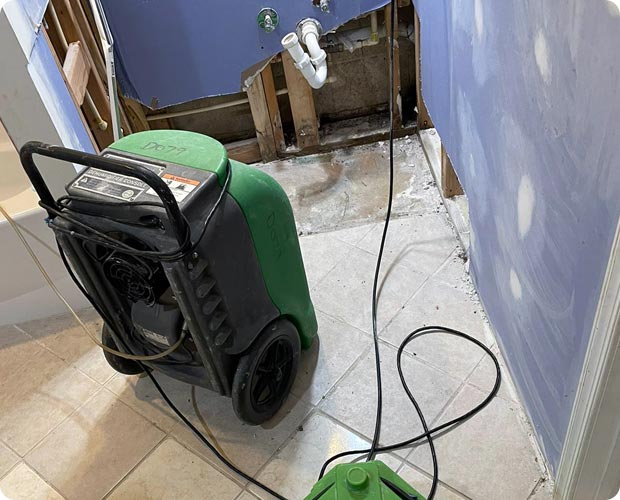
Clearance testing is the final step of any IICRC S520-compliant mold remediation and the critical quality control measure that confirms the work was done correctly. The clearance test must be performed by an independent licensed mold assessor — the company or individual that performed the remediation cannot perform their own clearance test. This independence is mandated by the NYS 2015 Mold Law and is best practice in all markets.
The timing and conditions of clearance testing are specified in the written remediation protocol. Standard protocol requires that containment remains fully in place when samples are collected, that the HEPA-filtered negative air machine has been running for at least 4 hours before sampling, and that an outdoor control sample is collected simultaneously with indoor samples.