
Mold testing in Hollywood: what to know
Hollywood's homes tell two different stories depending on the neighbourhood. In Hollywood Lakes and Hollywood Hills, you'll find real 1920s–1940s bungalows — original wood-frame construction and ageing roofs that have held up beautifully but weren't built for the humidity and storms South Florida throws at them today. Elsewhere it's 1950s–1970s CBS (concrete block and stucco), the sturdier South Florida standard. Either way, the age of the roof and the flashing matters more than most people realise.
Living this close to the beach and the Intracoastal means constant salt air on top of year-round humidity above 70% — a genuinely tough combination for a building. In these conditions, an HVAC condensate leak or a bit of failed roof flashing can turn into visible mold in days, not weeks, so a musty smell here is worth taking seriously early rather than waiting to see if it goes away.
Hollywood has weathered its share of hurricanes, and if a property took on water during a past storm season and wasn't fully dried and inspected afterward, hidden mold in a wall cavity is a real possibility years later — this is exactly the kind of thing we find that a homeowner had no reason to suspect. The city's older, historic sections also still have some ageing cast-iron water mains prone to slow leaks, which can quietly saturate framing near a slab long before anyone notices.
Mold conditions in Hollywood
Common mold types in this area: Aspergillus/Penicillium (the most frequent finds — HVAC condensate issues and everyday interior humidity); Cladosporium (the dominant outdoor species in South Florida, elevated indoors once there's moisture); Stachybotrys chartarum ('black mold' — usually a post-storm or chronic roof-leak wall cavity, not a fresh event); Curvularia (a tropical species common to South Florida's climate).
We serve Hollywood Beach Broadwalk, ArtsPark at Young Circle, Seminole Hard Rock Hotel & Casino, Topeekeegee Yugnee (TY) Park, Downtown Hollywood and the wider Hollywood area across ZIP codes 33020, 33019, 33021, 33023, 33024.
Signs you need mold testing
- Unexplained musty odour with no visible mold
- Health symptoms that improve when occupants leave the building
- Post-remediation verification that work was completed successfully
- Pre-purchase due diligence on a home or commercial property
- Landlord-tenant dispute requiring independent third-party documentation
- Insurance claim requiring laboratory evidence of mold type and extent
How we handle mold testing in Hollywood
Mold testing is not the same as a mold inspection. Testing refers specifically to the collection and laboratory analysis of air or surface samples to identify mold species and quantify spore concentrations. An inspection includes testing but also includes a visual survey, moisture mapping, and a written remediation protocol. Testing alone — without the inspection context — can produce data that is difficult to interpret correctly.
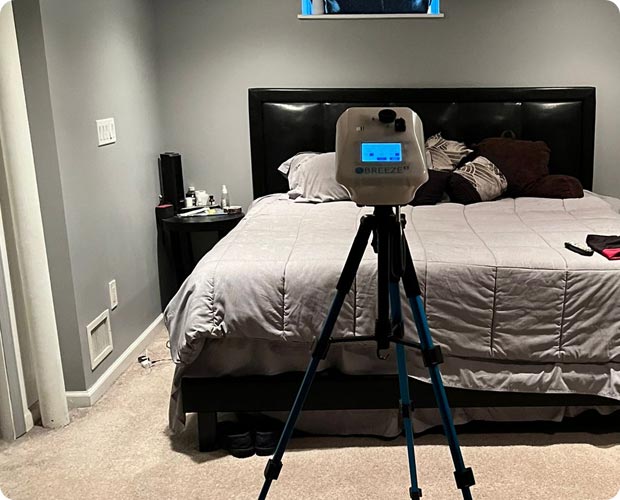
Air sampling for mold uses impaction cassettes (Air-O-Cell, Zefon BioPump) that capture particles from a calibrated air volume onto a collection medium. The cassette is analysed by a qualified analyst under microscopy. Results are reported as spores per cubic metre for each species identified. Critically, indoor samples must always be compared to an outdoor control sample taken simultaneously — outdoor spore counts vary by season, weather, and location.