
Skip to content
Licensed mold remediation — call to schedule
ES
MoldAct logo MoldAct IICRC S520 Certified Mold Remediation
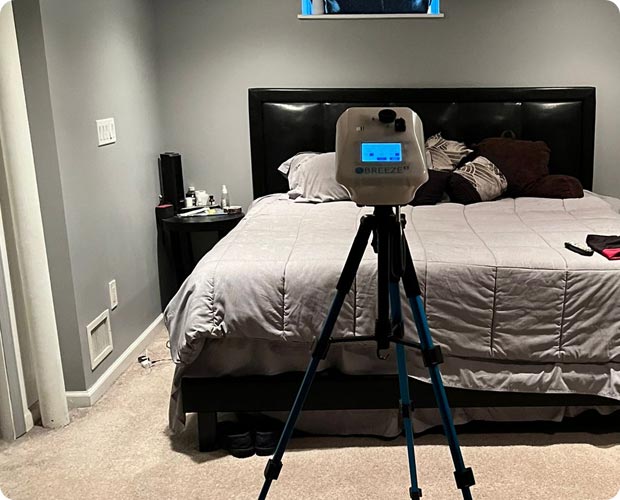
Indoor air quality technician collecting a mold air sample with a spore trap device

Mold Testing & Air Quality in Boca Raton, FL

Professional mold testing includes paired indoor/outdoor air cassette sampling, surface samples for Stachybotrys and Chaetomium, analysis at an AIHA-accredited laboratory, and a written report with species identification, spore counts, and interpretation — distinguishing elevated indoor levels from normal background.

Get Your Free Mold Inspection

Or call now: (877) 660-0430

Mold testing in Boca Raton: what to know

Most homes in Boca Raton are built the South Florida way — concrete block and stucco (CBS), a lot of it going up in the 1960s through 1990s along the canals and the Intracoastal. It's a solid way to build for hurricanes, but stucco cracks over time, and cracked stucco plus a failed pool-deck or window flashing is one of the most common ways moisture gets into an otherwise sound wall — quietly, behind the paint, long before you'd ever see it from the outside.

This is a genuinely humid place to live — near-daily afternoon thunderstorms from May through October and humidity sitting above 70% for most of the year. In that kind of climate, an HVAC condensate line or drain pan that fails doesn't give you weeks to notice it — mold can show up in days. If your AC has started smelling a bit off, that's worth listening to.

Boca Raton has been through real storms — Irma in 2017 and others since. If your property took on water back then and wasn't fully dried out and checked afterward, it's genuinely common for mold to still be sitting in a wall cavity or attic space years later, waiting to be found. That's not a scare story — it's just how South Florida construction and South Florida weather interact, and it's exactly the kind of thing an honest inspection is built to find.

Mold conditions in Boca Raton

Common mold types in this area: Aspergillus/Penicillium (the most common finds here — HVAC condensate failures and everyday interior humidity); Cladosporium (exterior stucco and the general outdoor background, elevated indoors once there's moisture); Stachybotrys chartarum ('black mold' — usually points to a post-storm or chronic HVAC-leak wall cavity, not a fresh, one-day event); Curvularia (a tropical species common to South Florida's climate).

We serve Mizner Park, Boca Raton Museum of Art, Florida Atlantic University, Red Reef Park, Royal Palm Place and the wider Boca Raton area across ZIP codes 33431, 33432, 33433, 33434, 33486.

Signs you need mold testing

  • Unexplained musty odour with no visible mold
  • Health symptoms that improve when occupants leave the building
  • Post-remediation verification that work was completed successfully
  • Pre-purchase due diligence on a home or commercial property
  • Landlord-tenant dispute requiring independent third-party documentation
  • Insurance claim requiring laboratory evidence of mold type and extent

How we handle mold testing in Boca Raton

Mold testing is not the same as a mold inspection. Testing refers specifically to the collection and laboratory analysis of air or surface samples to identify mold species and quantify spore concentrations. An inspection includes testing but also includes a visual survey, moisture mapping, and a written remediation protocol. Testing alone — without the inspection context — can produce data that is difficult to interpret correctly.

Air sampling for mold uses impaction cassettes (Air-O-Cell, Zefon BioPump) that capture particles from a calibrated air volume onto a collection medium. The cassette is analysed by a qualified analyst under microscopy. Results are reported as spores per cubic metre for each species identified. Critically, indoor samples must always be compared to an outdoor control sample taken simultaneously — outdoor spore counts vary by season, weather, and location.

Simple, transparent process

Our Boca Raton Mold Testing & Air Quality Process

  1. 1

    Sample strategy planning

    The assessor determines the number and location of samples based on the property size, symptom reports, and visible moisture indicators. At minimum, one outdoor control sample is collected simultaneously with every indoor sample.

  2. 2

    Air sampling

    Air cassettes are operated at a calibrated flow rate (typically 15 L/min) for a fixed volume (usually 75–150 litres). Samples are collected in areas of concern and in unaffected areas for comparison.

  3. 3

    Surface sampling

    Tape-lift samples are taken from visible mold growth for species identification. Swab samples are taken from irregular or wet surfaces. Bulk samples (material pieces) may be taken from heavily contaminated substrates for culture analysis.

  4. 4

    AIHA laboratory analysis

    All samples are chain-of-custody shipped to an AIHA-accredited laboratory. Standard turnaround is 3–5 business days; rush (24–48 hour) service is available. The lab report identifies all species detected and quantifies spore counts per cubic metre.

  5. 5

    Written interpretation report

    The licensed assessor interprets the laboratory data in the context of the property inspection findings, identifies elevated species, and provides a written report with conclusions and, if remediation is indicated, a protocol.

Mold Testing & Air Quality in Boca Raton — FAQs

Do you provide mold testing in Boca Raton?

Yes — MoldAct provides mold testing throughout Boca Raton, FL (ZIP codes: 33431, 33432, 33433, 33434, 33486) and surrounding Florida areas. Call us to book the earliest available appointment.

Are DIY mold test kits reliable?

DIY petri-dish and swab test kits sold at home improvement stores have very poor reliability. They detect almost anything that settles in the dish (including harmless outdoor molds), produce no quantitative data, and cannot tell you what is elevated compared to outdoor background. Professional AIHA-accredited laboratory analysis is the only defensible standard.

How many samples do I need?

At minimum, one indoor sample per area of concern plus one outdoor control. A standard residential assessment typically uses 3–6 samples. Properties with multiple suspect areas, post-remediation clearance, or legal disputes typically require more.

What is a 'normal' mold count?

There is no OSHA or EPA regulatory standard for indoor mold spore counts. The standard interpretation is that indoor species and concentrations should mirror outdoor background. Elevated indoor levels of any species not present outdoors, or indoor counts significantly higher than outdoor counts for the same species, indicate an indoor mold problem.

Mold Testing & Air Quality in Boca Raton — book today

Licensed, insured mold remediation contractors. Call to schedule.

Call Now Free Quote