
Mold testing in Dupont Circle: what to know
If you're in one of Dupont Circle's grand old rowhouses or converted mansions — many built between the 1870s and 1900s for the era's wealthy elite, later carved up into apartments and embassies — your unit may have plumbing added decades after the building itself, buried in old masonry walls that were never designed for a modern bathroom or kitchen's ventilation needs. That's a common, hidden source of interior wall mold, and it's not something you'd see coming.
A lot of Dupont's buildings have a raised English basement below street level, the same configuration you'll find across DC's historic core — structurally the deepest, dampest, least-ventilated part of the building, and usually the first place a musty smell shows up. If that's your unit, a smell you can't place isn't something to wait out.
You're in a dense embassy-row block layout here, and a lot of these buildings share party walls and aging drainage easements between properties — so a moisture problem next door doesn't always stay next door. If you've never had an issue but suddenly do, that's often exactly why.
Mold conditions in Dupont Circle
Common mold types in this area: Penicillium/Aspergillus (retrofitted bathrooms and kitchens without adequate ventilation); Cladosporium (window trim and masonry, elevated in summer humidity); Stachybotrys chartarum (chronic English-basement dampness in pre-1900s masonry); Chaetomium (long-standing leaks in converted multi-unit buildings).
We serve Dupont Circle Fountain, Embassy Row, The Phillips Collection, Kramerbooks, Rock Creek Park (nearby) and the wider Dupont Circle area across ZIP codes 20036, 20009.
Signs you need mold testing
- Unexplained musty odour with no visible mold
- Health symptoms that improve when occupants leave the building
- Post-remediation verification that work was completed successfully
- Pre-purchase due diligence on a home or commercial property
- Landlord-tenant dispute requiring independent third-party documentation
- Insurance claim requiring laboratory evidence of mold type and extent
How we handle mold testing in Dupont Circle
Mold testing is not the same as a mold inspection. Testing refers specifically to the collection and laboratory analysis of air or surface samples to identify mold species and quantify spore concentrations. An inspection includes testing but also includes a visual survey, moisture mapping, and a written remediation protocol. Testing alone — without the inspection context — can produce data that is difficult to interpret correctly.
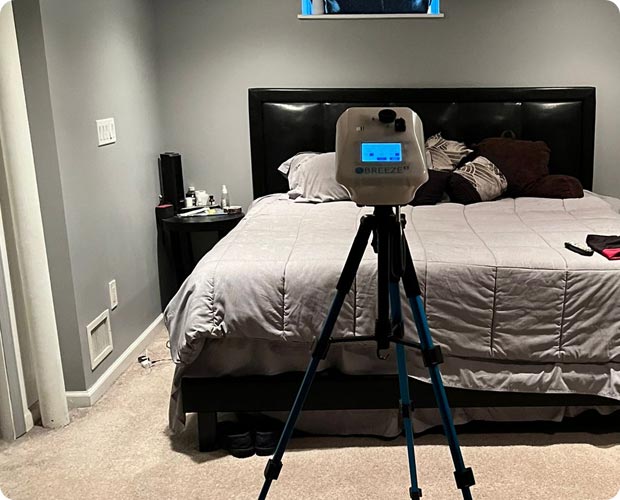
Air sampling for mold uses impaction cassettes (Air-O-Cell, Zefon BioPump) that capture particles from a calibrated air volume onto a collection medium. The cassette is analysed by a qualified analyst under microscopy. Results are reported as spores per cubic metre for each species identified. Critically, indoor samples must always be compared to an outdoor control sample taken simultaneously — outdoor spore counts vary by season, weather, and location.