
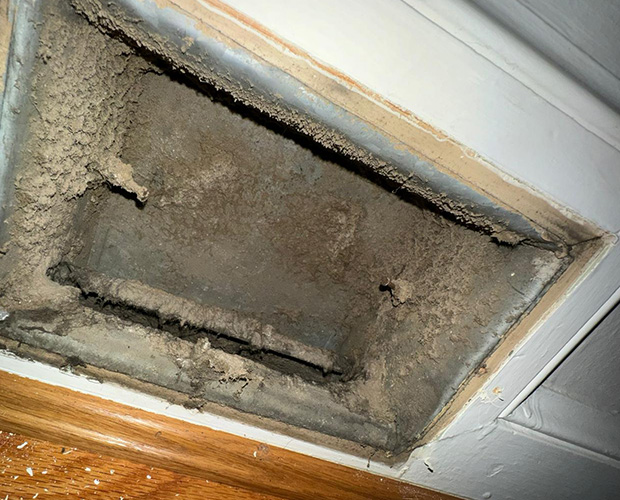
HVAC mold cleaning in Plano: what to know
Plano's housing stock is dominated by 1970s–2000s master-planned suburban construction on slab-on-grade foundations — the same Blackland Prairie clay soils that affect the broader Dallas-Fort Worth metro cause foundation movement that cracks slabs and lets moisture migrate into subfloor and wall-base assemblies.
North Texas's hot, humid summers combined with intense spring rain events put steady pressure on roofing and HVAC systems in Plano's aging first-generation subdivisions, where original ductwork and drain pans are increasingly prone to condensate failures.
Many Plano homes have finished basements or below-grade utility rooms far less often than the mid-Atlantic and Northeast markets, but slab-plumbing leaks under the foundation are a distinctly Texas mold driver — water travels laterally under the slab and can surface mold at baseboards well away from the original leak.
Mold conditions in Plano
Common mold types in this area: Aspergillus/Penicillium (HVAC systems and slab-leak moisture migration); Cladosporium (exterior surfaces and ambient outdoor background); Stachybotrys chartarum (chronic under-slab or foundation-crack moisture); Chaetomium (water-damaged drywall from slab leaks).
We serve Legacy West, The Shops at Willow Bend, Arbor Hills Nature Preserve, Haggard Park, Historic Downtown Plano and the wider Plano area across ZIP codes 75093, 75023, 75024, 75025, 75074.
Signs you need HVAC mold cleaning
- A musty or 'wet dog' smell when the HVAC system kicks on
- Visible mold or discolouration around a vent, air handler closet, or condensate line
- Water staining or dampness in a master-bath air handler closet
- Allergy-type symptoms that worsen specifically when the AC is running
- Recurring condensate line clogs or overflow
How we handle HVAC mold cleaning in Plano
Standard duct cleaning and HVAC mold remediation are not the same service, and the distinction matters. If mold is confirmed inside ductwork or on an air handler coil, that's a mold remediation scope under S520 — assessment, containment appropriate to the space, and treatment of the affected components — not a routine duct-cleaning appointment.
This service shows up with very different footprints across MoldAct's three markets. In Little Havana and Doral's residential sections, HVAC condensate overflow near the master-bath air handler closet is one of the single most common mold sources in Miami's climate — the closet configuration traps condensate that overflows onto drywall and subfloor before anyone notices. In Brickell's high-rise towers, the exposure is structural: centralised HVAC systems serving entire buildings mean a single coil or drain-pan failure can distribute spores to dozens of units through shared air handling, which is a very different scale and liability picture than a single-family condensate closet.