
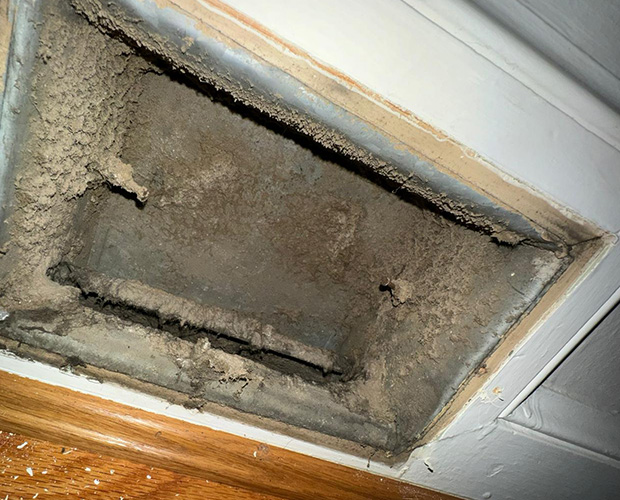
HVAC mold cleaning in Fort Worth: what to know
Fort Worth sits on the region's characteristic expansive clay soils — locally known as 'black gumbo' — which swell and shrink dramatically with rainfall and drought cycles, cracking slab foundations and pier-and-beam substructures and creating a persistent entry point for groundwater and mold.
The area's humid subtropical climate brings hot, humid summers followed by intense spring storm systems; homes built on slab-on-grade foundations (the dominant construction method across North Texas from the 1950s onward) are especially vulnerable to moisture wicking up through foundation cracks.
Older near-downtown and east-side neighbourhoods have aging cast-iron and clay sewer laterals that are prone to root intrusion and slow leaks, often saturating subfloor and slab-adjacent framing long before a leak is discovered.
Mold conditions in Fort Worth
Common mold types in this area: Aspergillus/Penicillium (HVAC systems and slab-foundation moisture); Cladosporium (exterior wood trim and ambient outdoor background); Stachybotrys chartarum (chronic slab-crack or plumbing-leak moisture); Chaetomium (water-damaged drywall and subflooring).
We serve Fort Worth Stockyards, Sundance Square, Kimbell Art Museum, Fort Worth Botanic Garden, Texas Christian University and the wider Fort Worth area across ZIP codes 76112, 76102, 76107, 76109, 76244.
Signs you need HVAC mold cleaning
- A musty or 'wet dog' smell when the HVAC system kicks on
- Visible mold or discolouration around a vent, air handler closet, or condensate line
- Water staining or dampness in a master-bath air handler closet
- Allergy-type symptoms that worsen specifically when the AC is running
- Recurring condensate line clogs or overflow
How we handle HVAC mold cleaning in Fort Worth
Standard duct cleaning and HVAC mold remediation are not the same service, and the distinction matters. If mold is confirmed inside ductwork or on an air handler coil, that's a mold remediation scope under S520 — assessment, containment appropriate to the space, and treatment of the affected components — not a routine duct-cleaning appointment.
This service shows up with very different footprints across MoldAct's three markets. In Little Havana and Doral's residential sections, HVAC condensate overflow near the master-bath air handler closet is one of the single most common mold sources in Miami's climate — the closet configuration traps condensate that overflows onto drywall and subfloor before anyone notices. In Brickell's high-rise towers, the exposure is structural: centralised HVAC systems serving entire buildings mean a single coil or drain-pan failure can distribute spores to dozens of units through shared air handling, which is a very different scale and liability picture than a single-family condensate closet.