HVAC mold cleaning in Hollywood: what to know
Hollywood's homes tell two different stories depending on the neighbourhood. In Hollywood Lakes and Hollywood Hills, you'll find real 1920s–1940s bungalows — original wood-frame construction and ageing roofs that have held up beautifully but weren't built for the humidity and storms South Florida throws at them today. Elsewhere it's 1950s–1970s CBS (concrete block and stucco), the sturdier South Florida standard. Either way, the age of the roof and the flashing matters more than most people realise.
Living this close to the beach and the Intracoastal means constant salt air on top of year-round humidity above 70% — a genuinely tough combination for a building. In these conditions, an HVAC condensate leak or a bit of failed roof flashing can turn into visible mold in days, not weeks, so a musty smell here is worth taking seriously early rather than waiting to see if it goes away.
Hollywood has weathered its share of hurricanes, and if a property took on water during a past storm season and wasn't fully dried and inspected afterward, hidden mold in a wall cavity is a real possibility years later — this is exactly the kind of thing we find that a homeowner had no reason to suspect. The city's older, historic sections also still have some ageing cast-iron water mains prone to slow leaks, which can quietly saturate framing near a slab long before anyone notices.
Mold conditions in Hollywood
Common mold types in this area: Aspergillus/Penicillium (the most frequent finds — HVAC condensate issues and everyday interior humidity); Cladosporium (the dominant outdoor species in South Florida, elevated indoors once there's moisture); Stachybotrys chartarum ('black mold' — usually a post-storm or chronic roof-leak wall cavity, not a fresh event); Curvularia (a tropical species common to South Florida's climate).
We serve Hollywood Beach Broadwalk, ArtsPark at Young Circle, Seminole Hard Rock Hotel & Casino, Topeekeegee Yugnee (TY) Park, Downtown Hollywood and the wider Hollywood area across ZIP codes 33020, 33019, 33021, 33023, 33024.
Signs you need HVAC mold cleaning
- A musty or 'wet dog' smell when the HVAC system kicks on
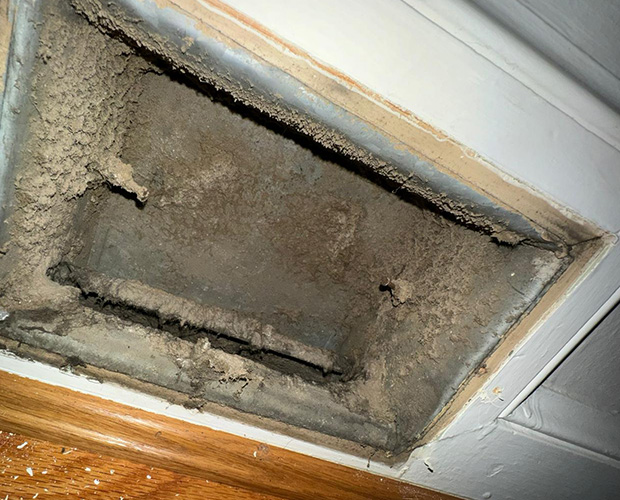
- Visible mold or discolouration around a vent, air handler closet, or condensate line
- Water staining or dampness in a master-bath air handler closet
- Allergy-type symptoms that worsen specifically when the AC is running
- Recurring condensate line clogs or overflow
How we handle HVAC mold cleaning in Hollywood
Standard duct cleaning and HVAC mold remediation are not the same service, and the distinction matters. If mold is confirmed inside ductwork or on an air handler coil, that's a mold remediation scope under S520 — assessment, containment appropriate to the space, and treatment of the affected components — not a routine duct-cleaning appointment.
This service shows up with very different footprints across MoldAct's three markets. In Little Havana and Doral's residential sections, HVAC condensate overflow near the master-bath air handler closet is one of the single most common mold sources in Miami's climate — the closet configuration traps condensate that overflows onto drywall and subfloor before anyone notices. In Brickell's high-rise towers, the exposure is structural: centralised HVAC systems serving entire buildings mean a single coil or drain-pan failure can distribute spores to dozens of units through shared air handling, which is a very different scale and liability picture than a single-family condensate closet.