
Skip to content
Licensed mold remediation — call to schedule
ES
MoldAct logo MoldAct IICRC S520 Certified Mold Remediation
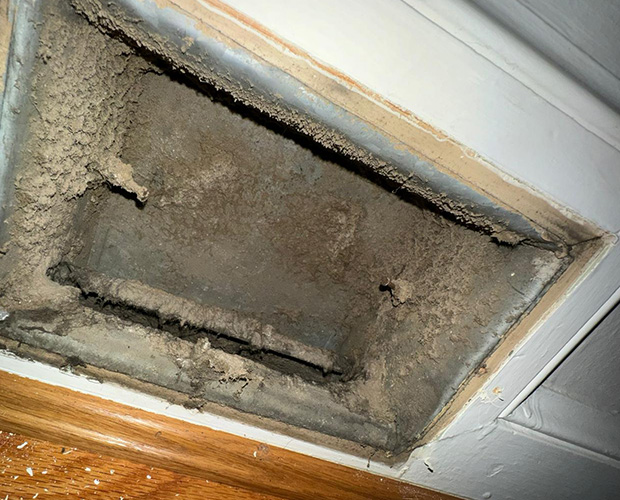
Mold buildup inside an aged HVAC unit's ductwork and components

HVAC Mold Cleaning in Capitol Hill, DC

HVAC mold — in ductwork, on the air handler coil, or in a condensate closet — is a distinct remediation scope, not standard duct cleaning, and it shows up differently across MoldAct's markets: HVAC condensate overflow is one of the most common mold sources in Miami's humid climate, while in Brickell's high-rise towers a single coil or drain-pan failure can distribute spores to multiple units through shared air handling.

Get Your Free Mold Inspection

Or call now: (877) 660-0430

HVAC mold cleaning in Capitol Hill: what to know

If you're on Capitol Hill, you're in the largest historic rowhouse district in the country — most of these Victorian-era homes were built between 1870 and 1910 with raised English basements and no exterior waterproofing membrane, the same fundamental vulnerability as Georgetown and Dupont but at a much bigger scale.

If you rent an English basement here, know that congressional turnover means a lot of Capitol Hill's rental units change hands every one to two years — a slow leak one tenant never mentions is often only found by the next person, well after mold has had time to establish.

You're close to the Anacostia River and on the same combined sewer infrastructure as much of the older city, so basement-level Category 3 water intrusion during a major storm is a recurring, documented issue here, not a rare one.

Mold conditions in Capitol Hill

Common mold types in this area: Stachybotrys chartarum ('black mold' — chronic English-basement dampness in unwaterproofed 19th-century foundations); Chaetomium (long-standing moisture from tenant-turnover-delayed leak reporting); Penicillium/Aspergillus (basement rental units with sustained humidity); Cladosporium (general background growth on trim and masonry).

We serve U.S. Capitol, Eastern Market, Lincoln Park, Barracks Row (8th Street SE), Folger Shakespeare Library and the wider Capitol Hill area across ZIP codes 20003, 20002.

Signs you need HVAC mold cleaning

  • A musty or 'wet dog' smell when the HVAC system kicks on
  • Visible mold or discolouration around a vent, air handler closet, or condensate line
  • Water staining or dampness in a master-bath air handler closet
  • Allergy-type symptoms that worsen specifically when the AC is running
  • Recurring condensate line clogs or overflow

How we handle HVAC mold cleaning in Capitol Hill

Standard duct cleaning and HVAC mold remediation are not the same service, and the distinction matters. If mold is confirmed inside ductwork or on an air handler coil, that's a mold remediation scope under S520 — assessment, containment appropriate to the space, and treatment of the affected components — not a routine duct-cleaning appointment.

This service shows up with very different footprints across MoldAct's three markets. In Little Havana and Doral's residential sections, HVAC condensate overflow near the master-bath air handler closet is one of the single most common mold sources in Miami's climate — the closet configuration traps condensate that overflows onto drywall and subfloor before anyone notices. In Brickell's high-rise towers, the exposure is structural: centralised HVAC systems serving entire buildings mean a single coil or drain-pan failure can distribute spores to dozens of units through shared air handling, which is a very different scale and liability picture than a single-family condensate closet.

Simple, transparent process

Our Capitol Hill HVAC Mold Cleaning Process

  1. 1

    HVAC-specific assessment

    We confirm whether mold is present in ductwork, on the coil, or at the condensate line/closet — this determines scope, since it's a different job from standard duct cleaning.

  2. 2

    Isolate the system

    The affected section of ductwork or the air handler is isolated before work begins, particularly important in shared-riser buildings like Brickell high-rises where one unit's contamination can reach neighbours.

  3. 3

    Containment and removal

    Contaminated components (insulation, affected ductwork sections) are removed and treated per S520 rather than sprayed and reassembled.

  4. 4

    Condensate system correction

    The condensate line, pan, or closet configuration causing the overflow is identified and flagged for repair — without that fix, the same failure recurs.

  5. 5

    Independent clearance

    A separate assessor confirms the system clears before it's put back into full service.

HVAC Mold Cleaning in Capitol Hill — FAQs

Do you provide HVAC mold cleaning in Capitol Hill?

Yes — MoldAct provides HVAC mold cleaning throughout Capitol Hill, DC (ZIP codes: 20003, 20002) and surrounding Washington DC areas. Call us to book the earliest available appointment.

Is HVAC mold cleaning the same as duct cleaning?

No. Standard duct cleaning is a maintenance service; if mold is confirmed in ductwork or on the air handler coil, that's a separate remediation scope under S520, not something a routine duct-cleaning visit resolves.

Why does my AC smell musty when it turns on?

That's a common sign of mold in the ductwork, on the coil, or at a condensate line/closet — especially in Miami's humid climate, where HVAC condensate overflow is one of the most frequent mold sources.

I live in a Brickell high-rise — could my neighbour's HVAC problem affect me?

Potentially, yes. Centralised HVAC systems serving an entire tower mean a coil or drain-pan failure in one unit can distribute spores through shared air handling to others — worth raising with building management if you suspect a building-wide issue, not just your own unit.

HVAC Mold Cleaning in Capitol Hill — book today

Licensed, insured mold remediation contractors. Call to schedule.

Call Now Free Quote