
Crawl space mold in Capitol Hill: what to know
If you're on Capitol Hill, you're in the largest historic rowhouse district in the country — most of these Victorian-era homes were built between 1870 and 1910 with raised English basements and no exterior waterproofing membrane, the same fundamental vulnerability as Georgetown and Dupont but at a much bigger scale.
If you rent an English basement here, know that congressional turnover means a lot of Capitol Hill's rental units change hands every one to two years — a slow leak one tenant never mentions is often only found by the next person, well after mold has had time to establish.
You're close to the Anacostia River and on the same combined sewer infrastructure as much of the older city, so basement-level Category 3 water intrusion during a major storm is a recurring, documented issue here, not a rare one.
Mold conditions in Capitol Hill
Common mold types in this area: Stachybotrys chartarum ('black mold' — chronic English-basement dampness in unwaterproofed 19th-century foundations); Chaetomium (long-standing moisture from tenant-turnover-delayed leak reporting); Penicillium/Aspergillus (basement rental units with sustained humidity); Cladosporium (general background growth on trim and masonry).
We serve U.S. Capitol, Eastern Market, Lincoln Park, Barracks Row (8th Street SE), Folger Shakespeare Library and the wider Capitol Hill area across ZIP codes 20003, 20002.
Signs you need crawl space mold
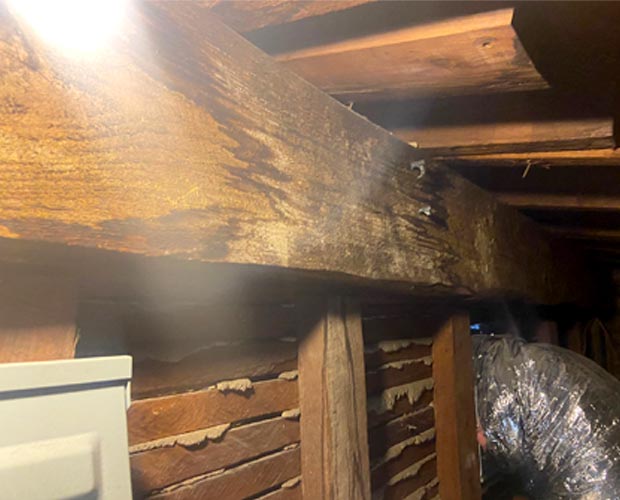
- Dark staining or fuzzy growth on floor joists or subfloor decking visible through the crawl-space access
- Musty odour rising from floor areas or floor registers
- Soft spots or springiness in floors above the crawl space
- Increased allergy or respiratory symptoms for ground-floor occupants
- Evidence of standing water, saturated soil, or moisture-damaged insulation in the crawl space
- Rust on metal fasteners, HVAC components, or pipes in the crawl space
How we handle crawl space mold in Capitol Hill
Crawl spaces are among the most neglected areas in residential construction and among the most common locations for extensive mold growth. Ground moisture vapour rises from unprotected soil, condenses on the cooler wood framing above, and creates the persistently humid environment that Cladosporium, Penicillium, Aspergillus, and Stachybotrys require to grow. In warm climates like Miami, humid outdoor air entering through vents creates the same problem.
Crawl space mold on floor joists and subfloor decking is particularly serious because it directly contacts the structural components that support the living areas above. Mold-colonised wood also experiences fungal decay (wood rot) over time, which can compromise structural integrity. Early remediation protects both air quality and structure.