
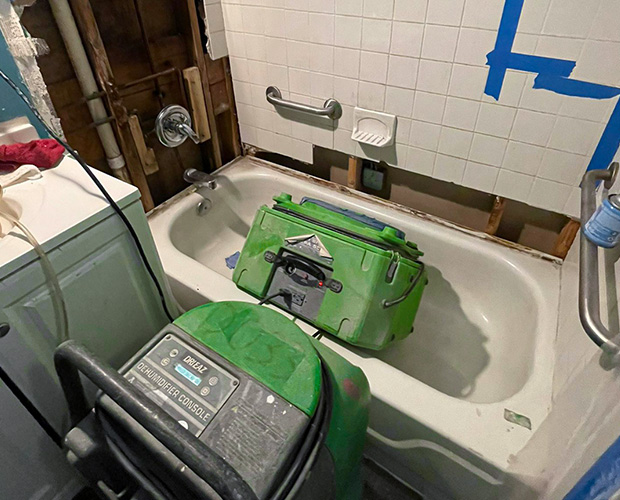
Bathroom mold removal in Woodbridge: what to know
If you're near the Potomac or Occoquan River in Woodbridge, low-lying, waterfront-adjacent property here has a documented history of stormwater and tidal-influenced flooding risk that inland Prince William County doesn't share — a below-grade room close to the water is worth extra scrutiny after any major storm.
A lot of Woodbridge's housing was built during the rapid suburban growth of the 1970s through 1990s, mostly slab and crawl-space construction, and the pace of that growth occasionally outran the stormwater infrastructure meant to serve it — undersized drainage in older subdivisions is a recurring, documented contributor to basement seepage.
Woodbridge's dense retail and commercial corridor around Potomac Mills runs large HVAC systems across big-box and mixed-use buildings, where condensate and drain-pan failures are the relevant commercial mold driver, distinct from what the surrounding residential subdivisions deal with.
Mold conditions in Woodbridge
Common mold types in this area: Cladosporium (crawl spaces and slab foundations across 1970s–1990s subdivisions); Stachybotrys chartarum (waterfront-adjacent flooding near the Potomac and Occoquan); Penicillium/Aspergillus (undersized subdivision drainage and commercial HVAC condensate); Chaetomium (long-standing moisture in older riverside properties).
We serve Potomac Mills, Occoquan River, Leesylvania State Park, Featherstone National Wildlife Refuge, Historic Occoquan (nearby) and the wider Woodbridge area across ZIP codes 22191, 22192, 22193.
Signs you need bathroom mold removal
- Black or greenish mould visible on grout lines, caulk, or tile surfaces
- Soft or spongy drywall at the base of the shower or bath surround
- Bubbling, cracked, or loose tiles — often indicating moisture migration behind
- Persistent musty odour in the bathroom after surface cleaning
- Staining on the ceiling below a bathroom (mold in subfloor or hidden leak)
- Visible mold at the base of toilet, vanity, or around plumbing penetrations
How we handle bathroom mold removal in Woodbridge
Bathroom mold is extremely common and ranges from minor surface growth on grout and caulk to serious structural mold growth behind tile, in wall cavities, and under subfloor decking. The difference matters enormously: surface mold on a non-porous substrate (glazed tile, sealed grout) can often be professionally cleaned without demolition; mold inside the wall cavity requires opening the wall, removing affected drywall and insulation, and following IICRC S520 protocol.
The most common bathroom moisture sources are: inadequate or non-functioning exhaust ventilation, grout and caulk failures that allow water into wall cavities, overflow from showers or tubs, and chronic toilet base leaks. In all cases, the moisture source must be corrected before any mold treatment — retiling over wet, contaminated drywall simply delays the problem.