
Bathroom mold removal in Cleveland Park: what to know
If you're in Cleveland Park, you're in one of DC's leafier, more suburban-feeling pockets of the city — a large detached Colonial Revival or Victorian house built from the 1890s through the 1930s, likely with a full basement and mature tree canopy that keeps your foundation shaded and slower to dry after rain than a sunnier block would be.
That mature tree canopy you love is a double-edged asset: heavy root systems from century-old trees are a well-documented cause of cracked and shifted foundation walls in this neighbourhood, and a cracked foundation wall is a direct path for groundwater into your basement.
If your home is original to the early 1900s, you may still have the original clay or cast-iron sewer lateral — root intrusion into those aging lines is a recurring source of slow leaks beneath and around foundations here, often long before anyone notices a symptom indoors.
Mold conditions in Cleveland Park
Common mold types in this area: Chaetomium (long-standing moisture from tree-root foundation cracks); Stachybotrys chartarum (chronic basement dampness under mature tree canopy); Cladosporium (shaded, slow-to-dry foundation walls and crawl spaces); Penicillium/Aspergillus (aging clay/cast-iron sewer lateral root intrusion).
We serve Cleveland Park Metro, Uptown Theater, Rock Creek Park, National Cathedral (nearby), Wardman Tower and the wider Cleveland Park area across ZIP codes 20008.
Signs you need bathroom mold removal
- Black or greenish mould visible on grout lines, caulk, or tile surfaces
- Soft or spongy drywall at the base of the shower or bath surround
- Bubbling, cracked, or loose tiles — often indicating moisture migration behind
- Persistent musty odour in the bathroom after surface cleaning
- Staining on the ceiling below a bathroom (mold in subfloor or hidden leak)
- Visible mold at the base of toilet, vanity, or around plumbing penetrations
How we handle bathroom mold removal in Cleveland Park
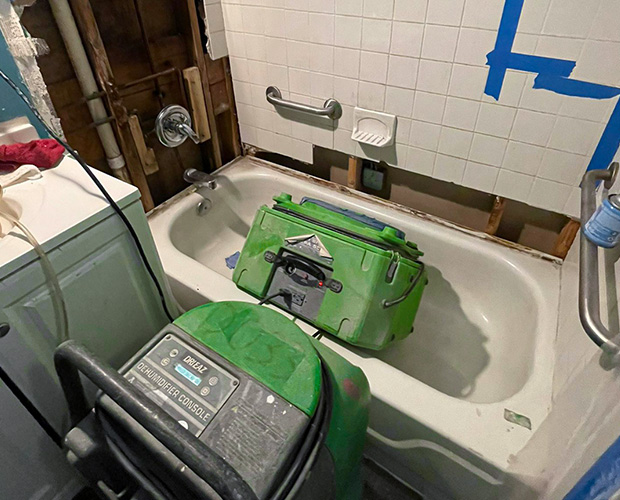
Bathroom mold is extremely common and ranges from minor surface growth on grout and caulk to serious structural mold growth behind tile, in wall cavities, and under subfloor decking. The difference matters enormously: surface mold on a non-porous substrate (glazed tile, sealed grout) can often be professionally cleaned without demolition; mold inside the wall cavity requires opening the wall, removing affected drywall and insulation, and following IICRC S520 protocol.
The most common bathroom moisture sources are: inadequate or non-functioning exhaust ventilation, grout and caulk failures that allow water into wall cavities, overflow from showers or tubs, and chronic toilet base leaks. In all cases, the moisture source must be corrected before any mold treatment — retiling over wet, contaminated drywall simply delays the problem.