
Bathroom mold removal in Accokeek: what to know
Accokeek is a rural-suburban community in southern Prince George's County on the Potomac River, bordering Charles County and served by Maryland Route 210 (Indian Head Highway).
Much of the area is wooded, low-density residential land. West of Route 210, the Moyaone Reserve is described as mid-century, individually designed homes on wooded lots of five acres or more. Homes on lots like these commonly have crawl spaces or basements, so drainage and plumbing leaks can go unnoticed for a long time.
Heavy tree cover and the nearby Potomac shoreline and creek valleys keep shaded roofs, siding and lower levels from drying out quickly, and the hot, humid mid-Atlantic summers add routine condensation risk to unconditioned crawl spaces.
Mold conditions in Accokeek
Common mold types in this area: Cladosporium (crawl-space and basement surfaces); Penicillium/Aspergillus (HVAC condensate and ductwork); Chaetomium (framing and drywall after slow roof or plumbing leaks); Stachybotrys (basement framing after persistent water intrusion).
We serve Piscataway Park, National Colonial Farm, Hard Bargain Farm and the wider Accokeek area across ZIP codes 20607.
Signs you need bathroom mold removal
- Black or greenish mould visible on grout lines, caulk, or tile surfaces
- Soft or spongy drywall at the base of the shower or bath surround
- Bubbling, cracked, or loose tiles — often indicating moisture migration behind
- Persistent musty odour in the bathroom after surface cleaning
- Staining on the ceiling below a bathroom (mold in subfloor or hidden leak)
- Visible mold at the base of toilet, vanity, or around plumbing penetrations
How we handle bathroom mold removal in Accokeek
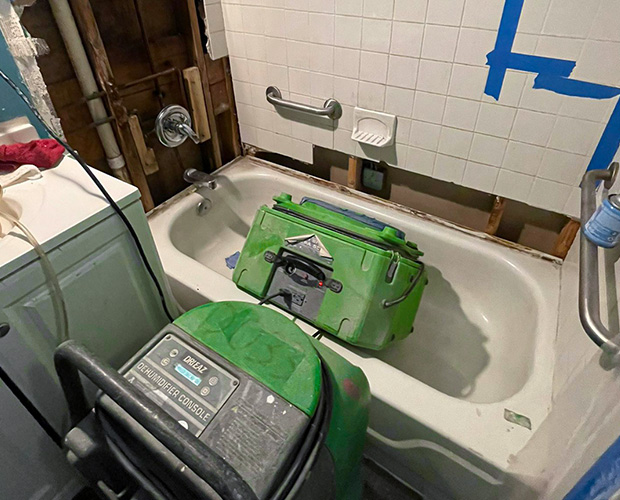
Bathroom mold is extremely common and ranges from minor surface growth on grout and caulk to serious structural mold growth behind tile, in wall cavities, and under subfloor decking. The difference matters enormously: surface mold on a non-porous substrate (glazed tile, sealed grout) can often be professionally cleaned without demolition; mold inside the wall cavity requires opening the wall, removing affected drywall and insulation, and following IICRC S520 protocol.
The most common bathroom moisture sources are: inadequate or non-functioning exhaust ventilation, grout and caulk failures that allow water into wall cavities, overflow from showers or tubs, and chronic toilet base leaks. In all cases, the moisture source must be corrected before any mold treatment — retiling over wet, contaminated drywall simply delays the problem.