
Attic mold removal in Laurel: what to know
If you're in Laurel's historic mill-town core along the Patuxent River, you're likely in a home dating back over a century to the town's original textile-mill economy — older wood-frame and masonry construction with the same lack of modern waterproofing seen in older housing stock throughout the region.
Sitting almost exactly halfway between DC and Baltimore, Laurel gets the same humid mid-Atlantic summers as both cities, and its proximity to the Patuxent River means low-lying, river-adjacent properties have a real, documented flood risk after heavy regional storms.
Much of Laurel's newer housing, built from the 1960s through the 1990s as a bedroom community for both DC and Baltimore commuters, sits on standard slab and basement construction where HVAC and grading issues are more common drivers than historic masonry.
Mold conditions in Laurel
Common mold types in this area: Chaetomium (century-old mill-town wood-frame and masonry buildings); Stachybotrys chartarum (Patuxent River-adjacent flooding on low-lying properties); Cladosporium (slab and basement construction in 1960s–1990s subdivisions); Penicillium/Aspergillus (HVAC condensate issues in mid-century bedroom-community housing).
We serve Main Street Laurel Historic District, Patuxent River, Laurel Lakes, Riverfront Park, Montpelier Mansion (nearby) and the wider Laurel area across ZIP codes 20707, 20708, 20723.
Signs you need attic mold removal
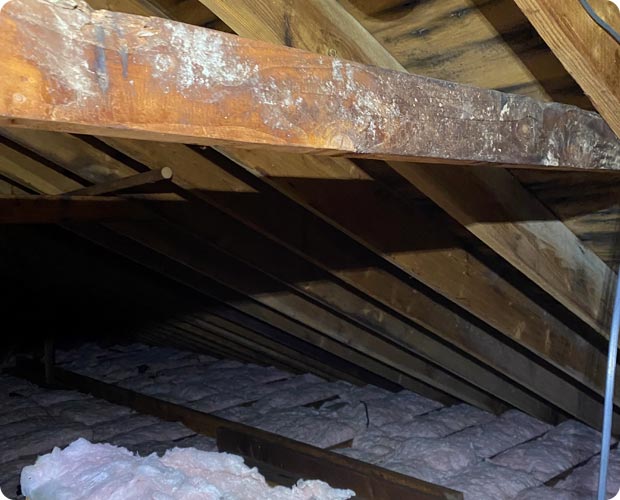
- Visible growth on the underside of the roof deck, rafters, or attic insulation
- Water staining on the ceiling of the top floor, which can indicate the source is actually above in the attic
- Musty odor noticeable when entering the attic
- A known roof, flashing, or gutter issue — especially on an older slate or ageing asphalt roof
- Condensation or frost visible on the underside of the roof deck in cold weather
How we handle attic mold removal in Laurel
Attic mold has two distinct causes, and telling them apart matters for the fix. The first is a physical leak: failed flashing, a cracked or missing roof shingle, or — in older neighbourhoods like Roland Park with original slate roofs and ageing copper gutters — a gutter or roofline failure that lets water into the attic after a storm, often going undetected for a stretch since attics aren't inspected daily. The second is condensation: warm, moist household air reaching a cold attic deck (common with poor ventilation or bathroom/kitchen exhaust fans vented into the attic instead of outside) condenses on the underside of the roof deck and rafters, growing mold without any storm or leak at all.
Cladosporium is the mold most often found in attics — it colonises wood framing and roof decking readily, particularly where ventilation is inadequate. Because attic spaces are rarely finished, this is often one of the more straightforward remediation jobs structurally, but access and containment in a tight, low-clearance space take particular care.