
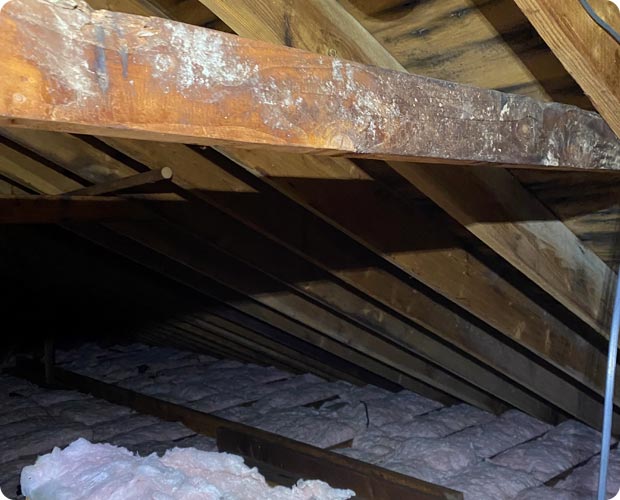
Attic mold removal in Hollywood: what to know
Hollywood's homes tell two different stories depending on the neighbourhood. In Hollywood Lakes and Hollywood Hills, you'll find real 1920s–1940s bungalows — original wood-frame construction and ageing roofs that have held up beautifully but weren't built for the humidity and storms South Florida throws at them today. Elsewhere it's 1950s–1970s CBS (concrete block and stucco), the sturdier South Florida standard. Either way, the age of the roof and the flashing matters more than most people realise.
Living this close to the beach and the Intracoastal means constant salt air on top of year-round humidity above 70% — a genuinely tough combination for a building. In these conditions, an HVAC condensate leak or a bit of failed roof flashing can turn into visible mold in days, not weeks, so a musty smell here is worth taking seriously early rather than waiting to see if it goes away.
Hollywood has weathered its share of hurricanes, and if a property took on water during a past storm season and wasn't fully dried and inspected afterward, hidden mold in a wall cavity is a real possibility years later — this is exactly the kind of thing we find that a homeowner had no reason to suspect. The city's older, historic sections also still have some ageing cast-iron water mains prone to slow leaks, which can quietly saturate framing near a slab long before anyone notices.
Mold conditions in Hollywood
Common mold types in this area: Aspergillus/Penicillium (the most frequent finds — HVAC condensate issues and everyday interior humidity); Cladosporium (the dominant outdoor species in South Florida, elevated indoors once there's moisture); Stachybotrys chartarum ('black mold' — usually a post-storm or chronic roof-leak wall cavity, not a fresh event); Curvularia (a tropical species common to South Florida's climate).
We serve Hollywood Beach Broadwalk, ArtsPark at Young Circle, Seminole Hard Rock Hotel & Casino, Topeekeegee Yugnee (TY) Park, Downtown Hollywood and the wider Hollywood area across ZIP codes 33020, 33019, 33021, 33023, 33024.
Signs you need attic mold removal
- Visible growth on the underside of the roof deck, rafters, or attic insulation
- Water staining on the ceiling of the top floor, which can indicate the source is actually above in the attic
- Musty odor noticeable when entering the attic
- A known roof, flashing, or gutter issue — especially on an older slate or ageing asphalt roof
- Condensation or frost visible on the underside of the roof deck in cold weather
How we handle attic mold removal in Hollywood
Attic mold has two distinct causes, and telling them apart matters for the fix. The first is a physical leak: failed flashing, a cracked or missing roof shingle, or — in older neighbourhoods like Roland Park with original slate roofs and ageing copper gutters — a gutter or roofline failure that lets water into the attic after a storm, often going undetected for a stretch since attics aren't inspected daily. The second is condensation: warm, moist household air reaching a cold attic deck (common with poor ventilation or bathroom/kitchen exhaust fans vented into the attic instead of outside) condenses on the underside of the roof deck and rafters, growing mold without any storm or leak at all.
Cladosporium is the mold most often found in attics — it colonises wood framing and roof decking readily, particularly where ventilation is inadequate. Because attic spaces are rarely finished, this is often one of the more straightforward remediation jobs structurally, but access and containment in a tight, low-clearance space take particular care.