
Skip to content
Licensed mold remediation — call to schedule
ES
MoldAct logo MoldAct IICRC S520 Certified Mold Remediation
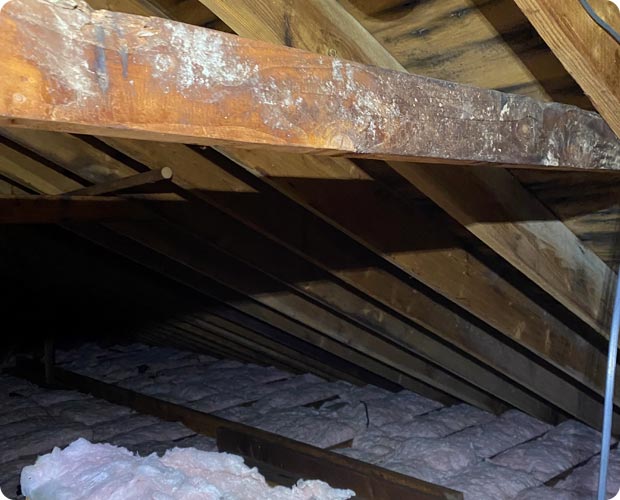
Mold growth spreading across attic roof sheathing and rafters

Attic Mold Removal in Columbia Heights, DC

Attic mold in MoldAct's markets is almost always a roof or ventilation problem before it's a mold problem — a failed gutter or ageing slate roof in a Roland Park-style older home, or condensation from poor attic ventilation — and remediation has to identify which one before treating what's growing on the rafters.

Get Your Free Mold Inspection

Or call now: (877) 660-0430

Attic mold removal in Columbia Heights: what to know

Columbia Heights was rebuilt densely in the early 1900s with rowhouses and mid-rise apartment buildings packed close together — if your building's roof or gutters fail, that water can go straight into the party wall of the place next door, not just your own.

If your block saw new construction during the 2000s redevelopment wave, know that a new-construction basement dug into a row of century-old party walls can disrupt drainage patterns that had quietly kept older neighbouring foundations dry for decades — sometimes that's exactly why a long-dry basement suddenly isn't.

You're on DC's older combined sewer system here like much of the historic core, so a hard summer storm can push Category 3 water into your basement — a documented pattern in this neighbourhood, not a one-off.

Mold conditions in Columbia Heights

Common mold types in this area: Chaetomium (party-wall moisture transfer between densely packed rowhouses); Stachybotrys chartarum (drainage disruption from new-construction basement digs); Penicillium/Aspergillus (mid-rise apartment plumbing stacks); Cladosporium (general background growth, humid summer months).

We serve DC USA / 14th Street retail corridor, Tivoli Theatre, Meridian Hill Park, Columbia Heights Metro, Banneker Recreation Center and the wider Columbia Heights area across ZIP codes 20010, 20009.

Signs you need attic mold removal

  • Visible growth on the underside of the roof deck, rafters, or attic insulation
  • Water staining on the ceiling of the top floor, which can indicate the source is actually above in the attic
  • Musty odor noticeable when entering the attic
  • A known roof, flashing, or gutter issue — especially on an older slate or ageing asphalt roof
  • Condensation or frost visible on the underside of the roof deck in cold weather

How we handle attic mold removal in Columbia Heights

Attic mold has two distinct causes, and telling them apart matters for the fix. The first is a physical leak: failed flashing, a cracked or missing roof shingle, or — in older neighbourhoods like Roland Park with original slate roofs and ageing copper gutters — a gutter or roofline failure that lets water into the attic after a storm, often going undetected for a stretch since attics aren't inspected daily. The second is condensation: warm, moist household air reaching a cold attic deck (common with poor ventilation or bathroom/kitchen exhaust fans vented into the attic instead of outside) condenses on the underside of the roof deck and rafters, growing mold without any storm or leak at all.

Cladosporium is the mold most often found in attics — it colonises wood framing and roof decking readily, particularly where ventilation is inadequate. Because attic spaces are rarely finished, this is often one of the more straightforward remediation jobs structurally, but access and containment in a tight, low-clearance space take particular care.

Simple, transparent process

Our Columbia Heights Attic Mold Removal Process

  1. 1

    Roof and ventilation inspection

    We determine whether the source is a physical leak (roof, flashing, gutter) or condensation from inadequate attic ventilation — the fix is different for each.

  2. 2

    Moisture mapping

    Moisture meters and thermal imaging locate wet framing and decking, including areas not visibly stained yet.

  3. 3

    Containment for a confined space

    Attic containment accounts for the tight, low-clearance access typical of these spaces, with HEPA vacuuming before any material removal.

  4. 4

    Removal and treatment

    Contaminated insulation is removed and disposed of; wood framing and decking are mechanically cleaned and antifungal-treated rather than replaced where structurally sound.

  5. 5

    Source correction confirmation

    Roof, flashing, gutter, or ventilation fixes are confirmed — by a roofer if needed — before the attic is closed back up, since re-growth without source correction is close to guaranteed.

Attic Mold Removal in Columbia Heights — FAQs

Do you provide attic mold removal in Columbia Heights?

Yes — MoldAct provides attic mold removal throughout Columbia Heights, DC (ZIP codes: 20010, 20009) and surrounding Washington DC areas. Call us to book the earliest available appointment.

How do I know if my attic mold is from a leak or just condensation?

A roof leak usually shows a stain pattern tracing to one spot — near a flashing point, valley, or gutter. Condensation-driven mold spreads more evenly across the roof deck and is worse in winter. An inspection with moisture mapping distinguishes the two.

Does attic mold mean my roof needs replacing?

Not necessarily — a localised flashing or gutter fix is common. A full roof assessment by a roofer determines that; the mold remediation job is confirming the source is fixed, not replacing the roof itself.

Can attic mold spread into my living space?

Water migrating down from an attic leak into ceiling and top-floor wall cavities is a real pathway — that's why an attic mold job typically includes checking the ceiling and walls immediately below it, not just the attic itself.

Attic Mold Removal in Columbia Heights — book today

Licensed, insured mold remediation contractors. Call to schedule.

Call Now Free Quote